Migrating Insurance Policy Administration Systems to AWS Without Downtime

A policy administration system is the least forgiving migration target in enterprise IT. It holds the record of what every customer is covered for, it is the system of truth for premium calculation, and it cannot be unavailable — a renewal that fails to process is a coverage question, not an inconvenience. Most carriers respond by not migrating at all, which is why so many are still running platforms commissioned in the previous decade.
The alternative to a big-bang cutover is not a slower big-bang cutover. It is a sequence of small, reversible moves in which the old system remains authoritative until each new component has proven itself against real traffic. This piece sets out that sequence.
Key Takeaways
- Never move the system of record first — move the read paths, then the integrations, then the write paths, and the core last or not at all.
- The strangler pattern works on policy systems because policy operations are naturally separable by product line and by transaction type.
- Dual-running costs more for a period and is the price of a reversible migration; budget it explicitly rather than compressing it.
- Reconciliation, not migration, is where these programmes actually consume time — plan for it as a workstream, not a task.
- Regulatory reporting continuity is a design constraint from day one, not a post-migration exercise.
Why the Big-Bang Cutover Keeps Failing
The traditional approach freezes change, migrates data over a weekend, cuts over, and hopes. It fails for structural reasons rather than execution ones.
Policy data is not clean. Decades of product changes, acquisitions, and manual corrections leave records that do not conform to the schema anyone believes is in force. A weekend is enough time to discover this and not enough to fix it.
Second, the blast radius is total. If the cutover goes wrong, every quote, renewal, endorsement, and claim is affected simultaneously, and the rollback — restoring the old system and replaying whatever happened in the meantime — is itself a high-risk operation performed under pressure.
Third, the freeze period is expensive. Halting product change for a quarter costs commercial ground, and the pressure to unfreeze early is what causes the corners to be cut.
The pattern that works instead is incremental — a variant of what is usually called the strangler fig approach: the old system stays authoritative, new components take over defined slices of behaviour one at a time, and each slice can be reverted independently.
Sequencing: Read, Integrate, Write, Core
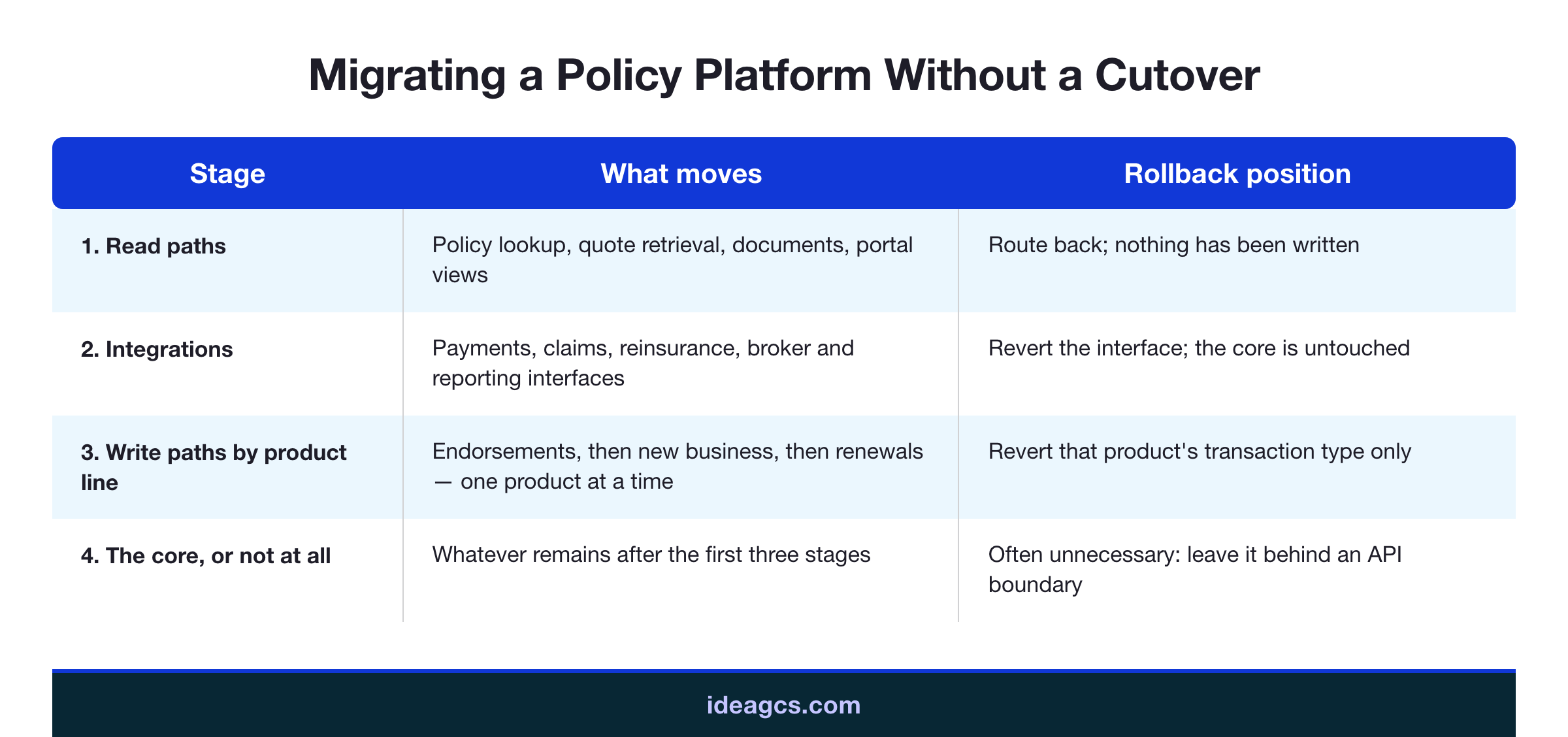
Read paths first. Quote retrieval, policy lookup, document generation, customer portal views. These are the highest-volume and lowest-risk operations, and they can be served from a replicated copy of the data without the old system knowing. If a read path misbehaves, you route back and nothing has been lost.
Integrations second. The interfaces to payment providers, reinsurance, claims platforms, brokers and regulatory reporting. Moving these onto a managed integration layer decouples the core system from everything around it, which is what makes the later steps possible at all. This is the step that most often gets skipped and most often should not be — our walkthrough of layered API design covers the structure, and the insurance-specific modernisation path covers the carrier context.
Write paths third, by product line. Endorsements on one product, then new business on that product, then renewals. Each transaction type on each product line is a separate, revertible move. Choose the smallest and least complex product first — usually a simple personal lines product rather than a commercial one.
The core last, or never. By the time reads, integrations, and the majority of write paths have moved, the residual core is smaller and less critical than it was. Some carriers complete the move; others find the remaining core is stable, low-change, and cheaper to leave where it is behind an API boundary. Both are legitimate outcomes, and deciding in advance which one you are aiming for is less useful than deciding when you get there.
Dual-Running and Reconciliation
For any period where both systems process the same transaction type, you are running two systems and paying for both. This is not waste; it is the mechanism that makes the migration reversible. Compressing it is the most common way these programmes turn into the big-bang cutover they were designed to avoid.
Reconciliation is the workstream that consumes the time. For each migrated transaction type, both systems process and the outputs are compared — premium calculated, documents generated, ledger entries posted. Differences are expected at first; the work is deciding which system is right, which is a business question rather than a technical one.
Two practical notes. First, automate the comparison from the start; manual reconciliation does not scale past the first product line. Second, treat a difference as information rather than a defect until it has been diagnosed — a meaningful proportion of discrepancies turn out to be long-standing errors in the legacy calculation that nobody had noticed.
Exit criteria should be defined before dual-running begins: a match rate, over a stated volume, sustained for a stated period. Without them, dual-running ends when someone loses patience.
Where Cloud Actually Helps
The elastic capacity argument is real but secondary for most carriers. Three other benefits do more work.
Environment reproducibility. Being able to stand up a full copy of the estate on demand changes what testing is possible. Migration rehearsals stop being annual events and become routine.
Data services. Managed replication, change data capture, and analytics tooling remove a large amount of the plumbing that would otherwise have to be built to support dual-running and reconciliation.
Recovery posture. Most legacy policy platforms have a recovery plan that has not been tested end to end in years. A migration is an opportunity to establish one that has, and that is worth something independent of the migration itself.
The renewal and month-end peaks are where elasticity earns its keep, and they are also where a badly sized migration shows up first. Size against peak, not average.
Regulatory Continuity
Insurance regulators do not pause during a migration. Statutory returns, solvency reporting, and conduct obligations continue against whichever system holds the data.
Three design constraints follow. Reporting must be able to draw from both systems during dual-running, which usually means a reporting layer that sits above both rather than inside either. Data lineage must be demonstrable — where a figure in a return came from, through which transformation. And retention obligations must survive the migration; archived policy data has a retention period that does not reset because the platform changed.
Design these at the start. Retrofitting lineage onto a completed migration is one of the more expensive remediation exercises available in this sector. The wider compliance framing is covered in our notes on regulated-industry modernisation.
Staffing the Programme
These programmes need three capabilities that rarely sit in one team. Cloud and platform engineering, to build and run the target environment. Integration engineering, to decouple the core from its surroundings. And insurance domain knowledge, to adjudicate reconciliation differences and decide what "correct" means for a premium calculation.
The third is the scarcest and the one most often under-resourced. A programme staffed entirely with excellent engineers and no domain authority will produce a technically sound migration that nobody can sign off, because nobody can say whether the numbers are right.
IdeaGCS covers the engineering side through its product and application rebuild services and MuleSoft connectivity services, with capacity supplied through specialist hiring services where a carrier needs to hold the domain expertise internally.
Conclusion
Policy administration systems can be migrated without downtime, but not by making the cutover more careful. The move has to be decomposed into slices that are individually small, individually reversible, and validated against real traffic before the next one begins — reads, then integrations, then write paths by product line, then whatever core remains.
Budget dual-running honestly, treat reconciliation as a workstream rather than a task, design regulatory lineage in from the start, and staff the domain side as seriously as the engineering side. The programme takes longer than a big-bang plan claims to and considerably less long than a failed one actually does. Talk to IdeaGCS if you want a migration sequenced against your own product lines.
Frequently Asked Questions
What is most commonly under-resourced?

Can a policy administration system really be migrated with no downtime?
What should move first?
Why move integrations before write paths?
How long should dual-running last?
What causes reconciliation differences?
Do we have to migrate the core system at all?
How do we keep regulatory reporting continuous?
Which product line should go first?
How much does dual-running add to the cost?
Contact Us
Share on Social Media
Contact Us