The MuleSoft Vendor Evaluation Scorecard: 15 Questions

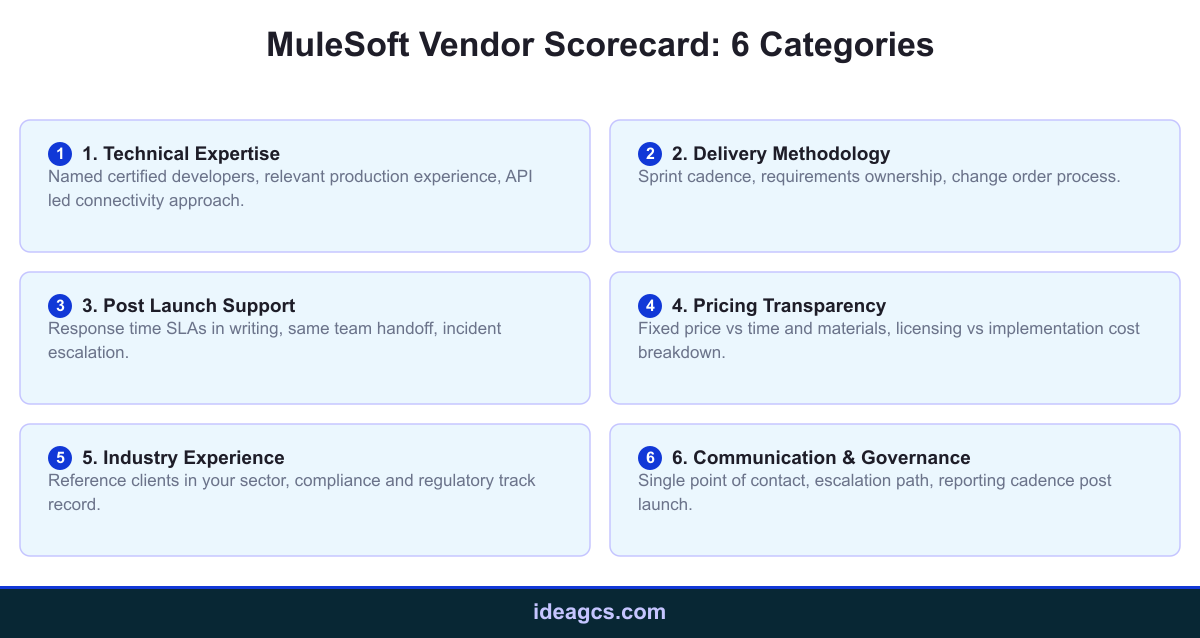
Choosing the wrong MuleSoft integration service provider is an expensive mistake to unwind once a contract is signed and a project is already underway. Most buyers evaluate partners on a sales deck and a gut feeling, then discover the gaps only after delivery slips, budgets balloon, or support goes quiet right when something breaks in production. This scorecard replaces that guesswork with 15 concrete questions across six categories: technical expertise, delivery methodology, post launch support, pricing transparency, industry experience, and communication and governance. Use it to compare proposals on evidence instead of polish, and to walk into vendor conversations already knowing what a strong answer sounds like versus a rehearsed one.
Key Takeaways
- Score every MuleSoft proposal across six categories: technical expertise, delivery methodology, post launch support, pricing transparency, industry experience, and communication and governance.
- Named certified developers and a written support SLA matter more than a polished sales deck.
- Fixed price versus time and materials terms should be spelled out before signing, not negotiated after scope creep appears.
Category 1: Technical Expertise
Anyone can claim MuleSoft experience. Push past the claim with specifics. First, ask the vendor to name the certified developers who will actually work on your project, not just the company's aggregate certification count across staff who will never touch your build. Second, ask for relevant production experience: integrations of similar scale, data volume, and system complexity to yours, not just any MuleSoft project the vendor can point to in a case study.
Third, ask how the team approaches API led connectivity architecture. A vendor who cannot explain system, process, and experience API layering in plain language, or who defaults straight to point to point connections under time pressure, likely has not designed one at real scale. Fourth, ask what happens when a senior developer leaves mid project. A vendor with no documented knowledge transfer plan is a continuity risk you are inheriting along with the integration. Finally, ask to see a sample of their Anypoint Studio project structure or DataWeave transformation code, even briefly, since messy or undocumented code is a strong predictor of expensive maintenance headaches down the line.
Category 2: Delivery Methodology
A strong technical team can still deliver a poor project if the delivery process is loose. Ask what sprint cadence they run and whether you will see working software every one to two weeks or only at the end of a long build phase with no visibility in between. Long silent stretches between demos are where scope drifts furthest from what was originally agreed.
Ask who owns requirements gathering and sign off, since ambiguity here is the single most common source of scope disputes on integration projects. Ask what the change order process looks like in writing, including how added scope gets priced and approved, before you need it rather than after a dispute has already started. A vendor who cannot describe this process clearly during sales will improvise it during delivery, usually in their favor.
Category 3: Post Launch Support
Integration work does not end at go live. Get response time SLAs in writing, tiered by severity, not a verbal promise to respond quickly when something breaks. Ask whether the team that built the integration also supports it after launch, since a full handoff to an unfamiliar support desk often means slower incident resolution and repeated explanations of context that the build team already had.
Ask how incident escalation works in practice: who gets paged, how fast, and what happens if the first responder cannot resolve the issue within an agreed window. Also ask how the vendor handles knowledge continuity if your integration sits mostly untouched for months, then suddenly needs a change. A support model that only works for actively maintained flows will struggle the moment your integration goes quiet and then needs attention again. Ask, finally, whether support hours align with your business hours or your users' time zones, not just the vendor's home office schedule.
Category 4: Pricing Transparency
Pricing structure affects your risk exposure as much as your budget. Ask directly whether the engagement is fixed price or time and materials, and understand what happens to cost if scope shifts under each model. Fixed price protects your budget on well defined work but can incentivize corner cutting if requirements were underscoped at signing.
Ask for a clear breakdown of licensing costs, which flow through to Salesforce or MuleSoft directly as platform fees, versus implementation costs, which are the vendor's own fee for the work performed. Vendors who resist breaking this down are often bundling margin into a single number they would rather you not scrutinize line by line. Also ask what is explicitly excluded from the quoted price, since exclusions are where change orders quietly begin, and ask how the vendor prices ongoing managed services once the initial build wraps, so you can budget the full lifecycle rather than only the first phase.
Category 5: Industry Experience
Generic integration skill does not always transfer cleanly across industries with different compliance requirements and legacy system landscapes. Ask for reference clients in your specific sector, not just broadly adjacent ones, and ask to speak with at least one directly rather than relying on a polished written testimonial the vendor selected and edited themselves.
Ask about the vendor's track record with the regulatory or compliance requirements relevant to your industry specifically, whether that is financial services reporting rules, healthcare data handling, or insurance recordkeeping standards. A team unfamiliar with those constraints will learn them on your project's timeline and your budget, instead of bringing that knowledge in already on day one of the engagement. Ask, too, whether they have integrated with the specific core systems common in your industry before, since prior familiarity with those systems' quirks often shortens the discovery phase meaningfully.
Category 6: Communication and Governance
The best technical team is undermined by poor communication structure. Confirm you get a single point of contact accountable for the engagement end to end, not a rotating cast of consultants with no clear owner when something goes wrong or a decision needs to be made quickly.
Ask what the escalation path looks like if that point of contact is unavailable or if you are not satisfied with progress on a recurring basis. Ask what the reporting cadence looks like after launch specifically, since ongoing visibility into system health, error rates, and flow performance matters as much post launch as visibility mattered during the original build.
Conclusion
Do not just read these 15 questions silently while reviewing a written proposal. Ask them out loud, in a live conversation, and pay close attention to how quickly and specifically each vendor answers. A team that has actually done this work before will answer the technical expertise and delivery methodology questions almost immediately, with names, numbers, and concrete examples rather than general reassurances. Hesitation, vague redirection to a case study PDF, or an answer that only restates your own question back to you are worth flagging, even if the rest of the pitch sounds strong. Score each of the six categories honestly during the call itself, then compare scores across every vendor you are evaluating side by side.
A MuleSoft integration service provider that can answer all 15 questions above clearly and specifically, without hedging or redirecting to a generic capability statement, is a fundamentally different kind of partner than one who leans on a polished pitch and a long client logo list. Bring this scorecard into your next vendor conversation, score each category honestly against what you actually hear, and use gaps in the answers as negotiation points before you sign a contract rather than problems you discover three months into delivery. If you already have a proposal in hand and want a second, independent opinion on it, talk to IdeaGCS and walk through it together.
Frequently Asked Questions
What is the single most important factor when choosing a MuleSoft integration service provider?

Should I choose fixed price or time and materials pricing for a MuleSoft project?
How do I verify a vendor's MuleSoft expertise beyond their sales pitch?
What should a MuleSoft support SLA include?
Is it a red flag if a vendor won't break down licensing versus implementation costs?
How many reference clients should I ask a MuleSoft vendor for?
What is a reasonable sprint cadence for a MuleSoft integration project?
Who should own requirements sign off on a MuleSoft integration project?
How is MuleSoft vendor evaluation different from evaluating general software vendors?
Where can I read more about comparing managed services against building an in house MuleSoft team?
Contact Us
Share on Social Media
Contact Us