Choosing a MuleSoft Development Company: In-House Build vs. Outsourced Partner Cost-Benefit

Every enterprise planning a MuleSoft integration project eventually faces the same fork in the road. Build the capability in house, or bring in a MuleSoft development company to do the work. Both paths can succeed. Both carry real costs that rarely show up in a simple quote comparison. This guide walks through a genuine cost benefit framework so you can weigh the two options on the numbers that actually matter, not just sticker price.
Key Takeaways
- In-house hiring carries hidden costs beyond salary: recruiting time, benefits load, tooling, certification, and ramp-up before a new hire is productive.
- An outsourced MuleSoft development company gets you started faster and gives you access to a bench of certified developers without a long-term headcount commitment.
- The right choice depends on project duration, internal governance needs, and how much day-to-day control your team requires over the integration roadmap.
The Real Cost of Building a MuleSoft Team In-House
Hiring a MuleSoft developer in house looks straightforward on paper. Post a role, interview candidates, make an offer. In practice, the timeline and cost run longer than most budgets account for, and the gap between the advertised salary and the true cost of the hire is where most build versus outsource comparisons go wrong.
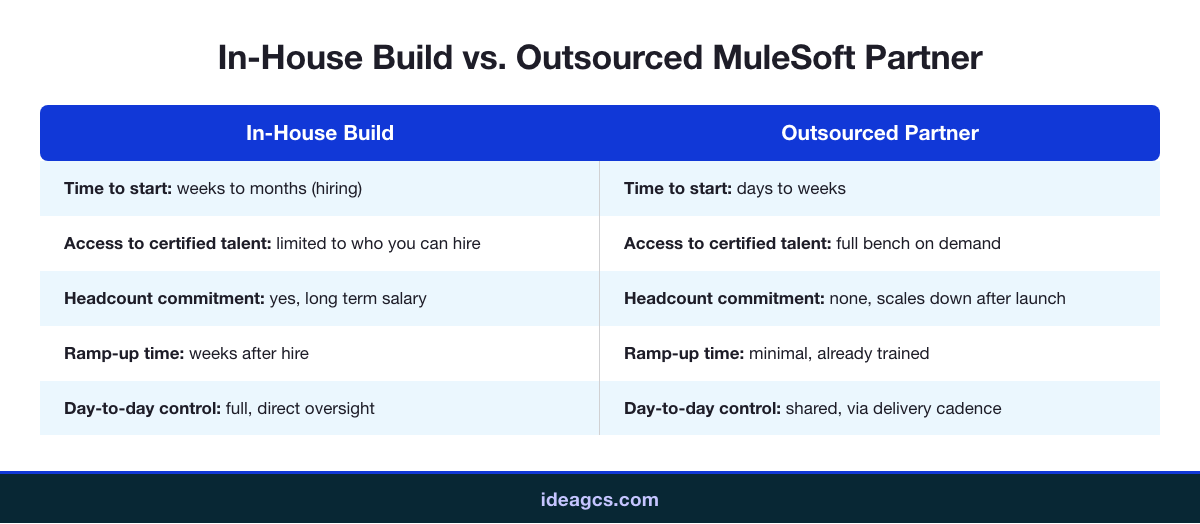
Certified MuleSoft developers are a narrow talent pool, and recruiting one typically takes several weeks to a few months depending on your market and compensation band. Roles requiring specific Anypoint Platform experience, DataWeave fluency, or API-led design background narrow the pool further, which stretches the search even longer for teams outside major tech hiring markets.
Once hired, salary is only part of the load. Benefits, payroll taxes, and overhead typically add 25 to 40 percent on top of base pay. Add Anypoint Platform training, certification exam costs, developer tooling licenses, and the ramp-up period before a new hire is fully productive on your specific integration landscape, and the true first-year cost of one in-house developer often runs well above the advertised salary figure that shows up in the job posting.
There is also retention risk. MuleSoft skills are in demand, and a developer you spent months hiring and training can leave for a better offer before the project that justified the hire is even finished. Replacing that person means restarting the entire recruiting and ramp-up cycle, often mid-project, which is one of the more expensive and disruptive outcomes a build versus outsource decision can produce.
None of this means in-house hiring is a bad idea. It means the comparison against outsourcing has to include these costs explicitly, not just the headline salary figure most budget conversations start with.
What You Get (and Give Up) with an Outsourced MuleSoft Development Company
Working with an outsourced MuleSoft development company flips the cost structure. Instead of paying to build a capability from zero, you pay for access to one that already exists, which changes both the timeline and the risk profile of the project.
The immediate advantage is speed. A development partner with a bench of certified developers can typically start scoping work within days, not the weeks or months a direct hire takes to source and onboard. For a project with a fixed deadline, that head start alone can be worth more than any per-hour rate difference between hiring and outsourcing.
You also get access to a range of skill levels on demand. A complex integration might need a senior architect for design and a mid-level developer for build work, with a QA specialist for testing near the end. Staffing that full mix in house means hiring three separate people for one project, each with their own recruiting timeline and ramp-up curve. An outsourced MuleSoft consulting services provider can assign the right mix for each phase of the project without you carrying any of those salaries permanently once the work is done.
Outsourcing also reduces the risk of a single point of failure. If one developer on an outsourced team is unavailable, the provider typically has coverage. If your one in-house MuleSoft hire is out sick or leaves the company, the project usually stalls until you find a replacement.
What you give up is some day-to-day control. An external team works on their own delivery cadence and reporting rhythm, which may not match your internal sprint structure exactly. Knowledge transfer also takes deliberate effort if you plan to bring maintenance in house later. Neither of these is disqualifying, but both deserve a real answer written into the contract before you sign, not an afterthought once the project is already underway.
A Simple Cost-Benefit Framework to Decide
Rather than defaulting to whichever option feels more familiar, run the decision through four concrete questions before committing budget either way.
First, how long is the work. A single integration project measured in months favors outsourcing, since the fixed cost of hiring rarely pays back on a short engagement. An ongoing programme of integration work spanning years starts to favor an internal team, since the training investment amortizes over far more delivered work, and institutional knowledge of your systems compounds in value over time.
Second, how specialized is the skill requirement. If your project needs deep MuleSoft development services experience across Anypoint Platform, DataWeave, and API-led design patterns, sourcing that in house from scratch is slower and riskier than engaging a partner who already has certified developers with that exact background on staff today.
Third, what happens after go-live. Someone has to monitor, patch, and extend the integration once it is running in production. Decide up front whether that ongoing work stays with the development partner under a support agreement or transfers to an internal team, and get pricing for both paths before the project starts rather than negotiating it under pressure after launch.
Fourth, how much governance and intellectual property control your organization requires. Regulated industries, or organizations with strict data residency and access control requirements, sometimes need integration work to stay fully in house for compliance reasons, even when the pure cost math favors outsourcing. This factor can override the other three on its own.
Score each project against these four questions before comparing vendor quotes to an internal hiring budget. Most organizations find the answer is clearer once the comparison includes these factors instead of just base cost per hour.
When In-House Still Wins
Outsourcing is not automatically the right answer for every organization or every project. Organizations running large, continuous integration programmes, or those in industries where regulatory requirements demand tight control over who touches production systems, often build internal MuleSoft capability deliberately, treating the higher upfront hiring cost as a long-term investment rather than a one-time expense to minimize.
Large enterprises with dozens of ongoing integration projects across multiple business units also tend to favor in-house teams once they cross a certain scale, because the fixed cost of maintaining internal expertise gets spread across enough concurrent work to justify it. A single department running one integration project rarely reaches that threshold on its own.
A practical middle path many enterprises use is hybrid staffing. Bring in an outsourced partner to handle the initial build and knowledge transfer, then hire internally for ongoing maintenance once the integration patterns are established and the hiring timeline is less urgent because the business is not waiting on a launch date. This lets you outsource the hardest, most time sensitive phase of the work while still building long-term internal capability on a schedule that fits your organization rather than the project deadline.
Whichever path you choose, write the decision down along with the reasoning. Six months into a project, it is easy to forget why build versus outsource was decided a certain way, and having the original cost-benefit analysis on hand makes it much easier to course-correct if circumstances change.
Conclusion
There is no universally correct answer to build versus outsource. The right choice depends on project timeline, how specialized the work is, what happens after launch, and how much governance control your organization needs. A short, well-defined integration project rarely justifies the full cost and risk of a new hire. A large, multi-year integration programme often justifies exactly that investment.
Run the numbers honestly, including the hidden costs of hiring that rarely make it into an initial budget conversation, and the decision usually becomes clear faster than expected. If you want a second opinion on which path fits your specific MuleSoft roadmap and timeline, talk to IdeaGCS about your project scope before committing budget either way.
Frequently Asked Questions
Is it cheaper to hire an in-house MuleSoft developer or use a MuleSoft development company?

How long does it take to hire a certified MuleSoft developer?
What does a MuleSoft development company typically include in its pricing?
Can I switch from an outsourced partner to an in-house team later?
Do outsourced MuleSoft teams work within our existing governance requirements?
What is the biggest hidden cost of building a MuleSoft team in house?
How many developers do I need for a typical MuleSoft integration project?
Is outsourcing MuleSoft development services less secure than building in house?
What happens to support and maintenance after an outsourced MuleSoft project ends?
How do I compare quotes from different MuleSoft consulting services providers?
Contact Us
Share on Social Media
Contact Us