DevOps for Healthcare IT: Balancing Deployment Speed With Compliance Requirements

Healthcare IT teams get asked for two things that sound contradictory. Ship changes faster, because clinicians are waiting and the patient portal is three releases behind. And prove, on demand, exactly who changed what, when, and under whose approval — because protected health information moves through these systems and a regulator may ask.
The contradiction is not real, but the way most hospital estates are set up makes it feel real. Manual release processes are slow and produce weak evidence, because the evidence is assembled afterwards from tickets, emails, and memory. A well-built pipeline is faster and produces better evidence, because the evidence is a by-product of the automation rather than a separate exercise. The administrative simplification requirements are what most of it is ultimately produced against.
Key Takeaways
- Manual change control is not safer than automated change control; it is just slower and harder to evidence.
- Separate the ability to approve a change from the ability to deploy it, and the largest audit objection disappears.
- Immutable, traceable artefacts turn "prove nothing changed between test and production" from an argument into a query.
- Clinical-hours awareness belongs in the deployment logic, not in a policy document nobody reads at 2pm on a Friday.
- Retrofitting audit evidence onto an existing pipeline costs several times what designing it in would have.
Why Manual Change Control Fails the Audit It Was Built For
The traditional hospital release process is a change advisory board, a form, and a maintenance window. It exists to satisfy governance, and it does so in the weakest possible way.
The form records that an approval happened. It does not record what was actually deployed, whether the artefact that reached production was the one that was tested, who had write access to the release directory in between, or what the rollback actually consisted of. When an auditor asks those questions, the answer is reconstructed from human recollection and ticket comments.
Meanwhile the process imposes real cost. Batching changes into a monthly window means each release is large, which makes each release risky, which justifies more scrutiny, which lengthens the window. Teams end up with the worst combination available: infrequent, high-risk releases with thin evidence.
Automation inverts every term. Small changes, released often, each one carrying its own machine-generated record of what was built, what was tested, what was scanned, who approved it, and where it went.
The Four Controls That Do Most of the Work
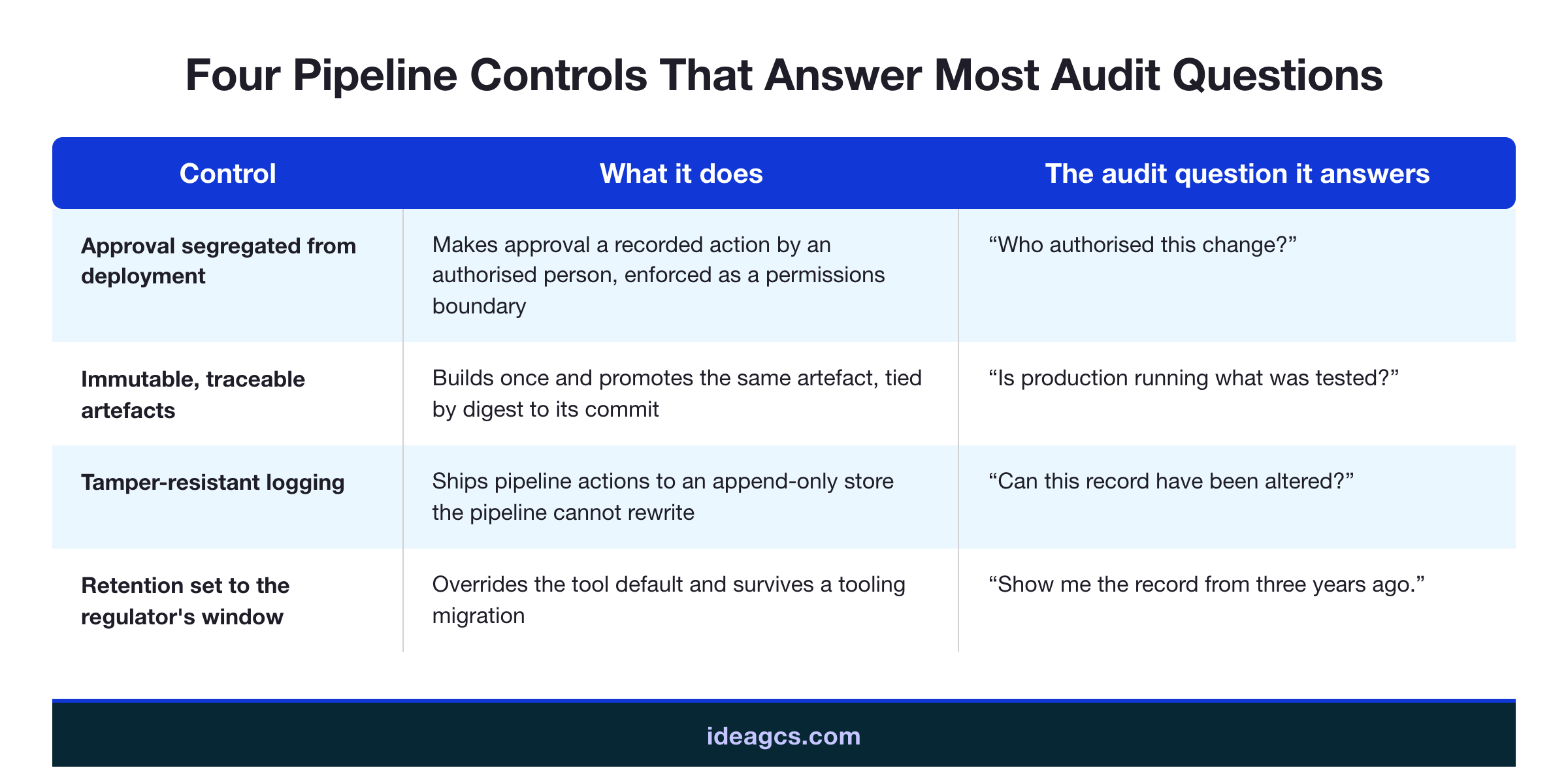
Regulated deployment does not require an exotic toolchain. Four design decisions cover the substantial majority of what an audit will ask about.
Segregate approval from deployment. The engineer who writes a change should not be able to unilaterally push it to production. In a pipeline this is a permissions boundary rather than a meeting — the approval is a recorded action by an authorised person, and the pipeline will not proceed without it. This single control answers more audit questions than any other.
Make artefacts immutable and traceable. Build once, promote the same artefact through environments, and tie it by cryptographic digest to the commit that produced it. "Is production running the code that was tested?" stops being a matter of process trust and becomes a matter of comparing two identifiers.
Log the pipeline's own actions somewhere the pipeline cannot rewrite. Deployment logs stored in the deployment system are weak evidence. Shipped to a separate append-only store with its own access controls, they are strong evidence.
Keep the evidence for the regulator's window, not the tool's default. Most build systems prune history aggressively. Retention needs to be set deliberately against the retention obligation, and it needs to survive a tooling migration.
Protected Data in Non-Production Environments
This is where healthcare estates most often fail an inspection, and it has nothing to do with the pipeline itself.
Test environments populated with a copy of production data contain protected health information, in systems with weaker access controls, monitored less closely, and frequently accessible to contractors. Every argument for doing it is an argument about test fidelity, and every one of them has an alternative.
Synthetic data generation covers most functional testing. Where genuine production shapes are needed, de-identification applied at the point of extraction — not after loading — keeps the exposure out of the lower environment entirely. Where a specific defect genuinely cannot be reproduced without real records, a time-boxed, logged, individually-approved copy into a controlled environment is defensible; a standing nightly refresh is not.
The pipeline's role is to make the safe path the default one, so that provisioning a test environment automatically provisions it with de-identified data rather than requiring someone to remember.
Deploying Around Clinical Reality
Software delivery guidance written for consumer platforms assumes that the worst case of a bad deploy is an annoyed user. In a hospital the worst case is a clinician unable to retrieve a record during care delivery, which is a different category of problem.
That does not argue for slower deployment. It argues for deployment that understands context. Three patterns do most of the work.
Encode the clinical calendar in the pipeline. Ward rounds, theatre lists, shift changes, and month-end billing runs are predictable. A pipeline that knows about them can refuse to deploy into a high-risk window automatically, rather than relying on an engineer to remember.
Make rollback the fast path. In healthcare the recovery time matters more than the failure rate. A pipeline that can revert in under a minute changes the risk calculus of every release, and it is worth optimising for ahead of almost anything else.
Progressive exposure before full release. Rolling a change to one department, then one site, then the estate limits the blast radius to something clinically survivable. This is more valuable than an extra testing stage, because it tests against reality rather than against assumptions.
Where the underlying systems have to keep talking to each other through all of this, the integration layer carries much of the load — the same argument set out in our walkthrough of connecting clinical, billing and claims systems without a rebuild.
Sequencing a Healthcare Estate
Most hospital IT estates cannot be automated in one programme, and attempting it is how these initiatives die. A workable sequence looks like this.
Start with a system that matters but is not clinically critical — the intranet, an internal reporting tool, a staff-facing portal. Build the full pipeline there, including approval segregation and evidence capture, and let it run for a quarter. You now have a working reference implementation and, more usefully, an audit conversation you have already had once.
Move next to a clinically adjacent system where a failure is disruptive but not dangerous. Patient communications, appointment scheduling, non-urgent portals. This is where progressive exposure and fast rollback get proven under real load.
Only then approach the systems where an outage affects care delivery, and approach them with the evidence pattern already accepted by your own governance function. By this point the argument is no longer "should we automate" but "here is what automation has already produced".
Third-party and vendor-managed clinical systems are usually the last frontier and sometimes never move. Plan for a permanently mixed estate, as covered in our notes on running hybrid infrastructure without pretending it is temporary.
What This Costs and What It Returns
The upfront cost is design time rather than licence spend. Establishing the control pattern on a first system is typically weeks of senior engineering work; replicating it onto subsequent systems is substantially cheaper each time.
The return arrives in three forms. Release frequency rises, which shortens the queue of clinician-requested changes that currently waits months. Unplanned work falls, because small changes fail less catastrophically than large ones. And audit preparation stops being a project — the evidence is already there, queryable, rather than assembled by a team for six weeks before an inspection.
That last one is routinely underweighted in business cases and is often the largest single saving in a hospital estate. IdeaGCS builds these pipelines through its delivery automation services, with the estate-side support handled through enterprise service-desk services.
Conclusion
Speed and compliance are not on opposite ends of a slider in healthcare IT. Manual change control is slow and evidences badly; automated change control with segregated approval, immutable artefacts, and tamper-resistant logging is fast and evidences well. The trade-off most teams believe in is an artefact of how their current process was built.
Design the audit trail in at the start, keep protected data out of lower environments by default, teach the pipeline about clinical hours, and sequence the rollout so the governance argument is won on a low-risk system before it is needed on a critical one. Talk to IdeaGCS if you want the first pipeline scoped against your own governance requirements.
Frequently Asked Questions
Does automated deployment satisfy HIPAA requirements?

Do we still need a change advisory board?
Can we use production data in test environments?
What is the single most valuable control to implement first?
How do we avoid deploying during critical clinical hours?
Is rollback speed really more important than release frequency here?
What about clinical systems managed by a third-party vendor?
How long does the first pipeline take to build?
Where should we start in a large hospital estate?
What is the biggest saving people leave out of the business case?
Contact Us
Share on Social Media
Contact Us