What US and UK Enterprises Actually Pay for Outsourced Delivery Engineering in 2026

Pricing in this market is opaque by habit rather than by design. Providers quote a monthly figure that bundles several very different things, buyers compare figures that are not comparable, and the resulting contract is renegotiated within a year because the scope everyone assumed was included turns out not to have been.
This piece sets out the commercial models actually in use across the US and UK, what moves the number in each direction, and the cost lines that buyers most often omit from the business case. It deliberately avoids publishing a single rate card, because the honest answer is that the same scope varies by a factor of three depending on estate complexity — and any provider quoting a firm number before seeing the estate is quoting for a different estate.
Key Takeaways
- Four commercial models dominate, and they allocate risk very differently — retainer, outcome-based, embedded capacity, and project-then-support.
- Estate complexity moves price far more than day rate does; the same nominal scope varies by roughly threefold across estates.
- The line buyers omit most often is their own team's time, which is frequently the largest single cost in the first year.
- A quote that does not distinguish build work from run work will be renegotiated, usually within twelve months.
- Cheap engagements get expensive through scope exclusions, not through rate increases.
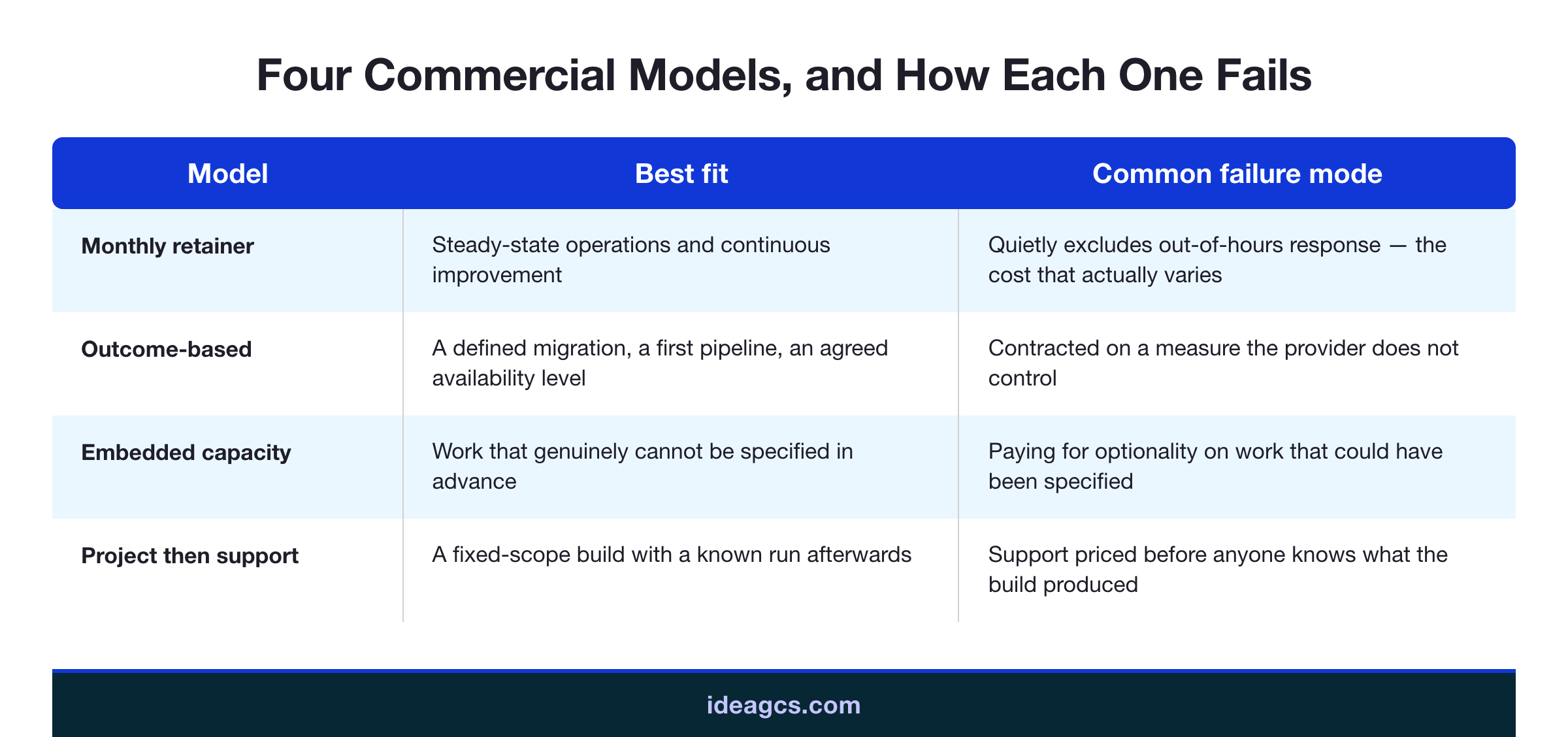
The Four Commercial Models
Monthly retainer
The most common shape. A fixed monthly fee buys a defined team or a defined capacity, typically expressed as a number of engineers or a number of days.
It is easy to budget and easy to compare on paper, which is exactly why it gets misused. A retainer is a capacity purchase, not an outcome purchase; if the estate turns out to need twice the work, the retainer does not stretch, and if it needs half, you pay for the half you did not use. It suits steady-state operations and continuous improvement well, and one-off transformation poorly. Where the objective is a measurable shift in delivery performance, an outcome-based structure fits better.
Watch for retainers that quietly exclude out-of-hours incident response, which is the cost that actually varies.
Outcome-based
The provider is paid against defined results — a pipeline delivered, a migration completed, an availability target sustained, a lead-time figure reached.
This is the model buyers say they want and rarely structure well. It only works where the outcome is unambiguously measurable and the provider genuinely controls the levers. Contracting on deployment frequency when your own change advisory board holds the gate produces a dispute, not an incentive. Where it does fit — a defined migration, a first pipeline, an agreed availability level with clear boundaries — it is the cleanest model available.
Embedded capacity
Named engineers work inside your teams under your prioritisation, billed by time. Effectively staffing, with a partner holding the employment risk.
Costs more per unit of delivery than a retainer and buys flexibility and integration in return. It is the right shape when the work cannot be specified in advance, and the wrong shape when it can, because you are paying for optionality you are not using. The comparison against direct hiring is set out in our look at how specialist hiring compares with outsourced recruitment models.
Project then support
A fixed-scope build followed by a lower ongoing fee to run what was built. Common, sensible, and the model most likely to be mispriced — because the support fee is quoted before anyone knows what the build will actually produce.
If you use this model, insist that the support pricing is set after the build completes, with a defined method rather than a defined number. Providers who resist this are pricing the risk of their own uncertainty into your ongoing fee.
What Actually Moves the Number
Day rate is the variable buyers negotiate hardest and the one that matters least. Five things move the total materially.
How many distinct systems are in scope. Cost scales with the number of independent deployment targets far more sharply than with lines of code. Ten services on one runtime is a smaller engagement than four services on four runtimes.
How much of the estate is documented. Undocumented systems are discovered rather than read, and discovery is the least predictable phase of any engagement. This is where the threefold variation lives.
Whether environments are reproducible today. If they are not, that work comes first and it is not small. Most quotes that come in surprisingly low have assumed it is already done.
Regulatory obligations. Audit-grade evidence, approval segregation, and retention design add design time at the start. Materially cheaper than retrofitting, but not free.
Coverage requirements. Business-hours support and 24/7 support are different products with different cost structures. A provider quoting one figure for both has priced neither properly.
The Lines Buyers Leave Out
Three costs are routinely absent from the business case, and together they are frequently larger than the provider fee itself in year one.
Your own team's time. Discovery, access provisioning, architectural decisions, review, testing support, and the ordinary friction of two organisations working on one estate. Budgeting zero for this is the most common single error, and it is not a small one — on complex estates it can rival the external fee.
The internal owner. Someone has to hold the architecture and the vendor relationship. This is not overhead; it is what prevents the engagement from becoming a dependency. It usually needs to be a senior person, and their time is not free.
Cloud spend during transition. Running old and new in parallel costs more than running either alone, and the parallel period is nearly always longer than planned. Our notes on where cloud cost actually accumulates cover the pattern.
Where Cheap Becomes Expensive
Low quotes are rarely dishonest. They are usually precise answers to a narrower question than the one you asked.
The recurring exclusions: out-of-hours incident response; environment reproducibility work; security and compliance gating; knowledge transfer and documentation; and the discovery required on undocumented systems. Each is defensible individually. Together they are most of the engagement.
The test is simple. Ask any provider to state explicitly what is not in scope, in writing, before comparing prices. The quality of that answer is a better predictor of the engagement than the number attached to it. Our red flags and green lights for evaluating a partner covers the wider diligence.
Building a Comparable Business Case
Four steps make competing quotes actually comparable.
First, split build from run explicitly, and require both to be priced separately. A single blended figure hides which one is being subsidised.
Second, define coverage precisely — hours, response times, escalation path, and what happens on a public holiday. This is where the largest unpriced variance sits.
Third, state the estate honestly, including what is undocumented. Providers will discover it anyway; the only question is whether it is priced in advance or as a variation.
Fourth, include your own costs — team time, internal owner, transition cloud spend — in the same model. A business case that compares an external fee against zero internal cost is not a comparison.
IdeaGCS scopes against this structure directly through its delivery automation services, and where the requirement turns out to be people rather than a delivered capability, through specialist hiring services.
Conclusion
There is no single market rate, and any provider offering one before seeing your estate is describing an average rather than a quote. What buyers can control is the structure of the comparison: build separated from run, coverage defined precisely, exclusions stated in writing, and internal cost included in the model.
Do that and the threefold variation in this market becomes explicable rather than mysterious. Skip it and the contract will be reopened within a year, on terms set by whichever party understood the scope better at signature. Talk to IdeaGCS if you want a scope priced against a stated estate rather than an assumed one.
Frequently Asked Questions
What is a typical monthly cost for outsourced delivery engineering?

Which commercial model is best?
Why do quotes for the same scope differ so widely?
What is the most commonly omitted cost?
Should build and run be priced together?
Does regulatory compliance increase the cost much?
How should we handle support pricing after a fixed-scope build?
Is 24/7 cover much more expensive than business hours?
How do we compare providers fairly?
When does hiring beat buying on cost?
Contact Us
Share on Social Media
Contact Us