Data Transformation vs Digital Transformation: Why IT Leaders Confuse Them, and Why It Matters

These two terms get used interchangeably in board papers and they should not be. They describe different work, funded differently, owned by different people, and delivering on different timescales. Conflating them produces a recognisable failure: a programme that promises business outcomes, spends its budget on data plumbing, and reports eighteen months in that the foundations are nearly ready.
The distinction is not academic. It determines who sponsors the work, what gets measured, and in what order the money is spent.
Key Takeaways
- Data work changes what the organisation can know; digital change alters how it operates. One enables the other.
- Nearly every stalled digital programme is stalled on a data dependency that was not scoped.
- Data work is largely invisible to the business, which is why it needs its own funding line and its own measures.
- Sequencing rule: enough data work to unblock the first digital increment — not all of it, and not none of it.
- Different owners, different measures, one plan.
What Each One Actually Is
Data transformation is work on the information asset. Consolidating sources that disagree, defining what a customer or a policy or a product actually is across systems that each have their own view, fixing quality at origin rather than in reports, establishing lineage so a number can be traced to where it came from, and putting governance around who may use what.
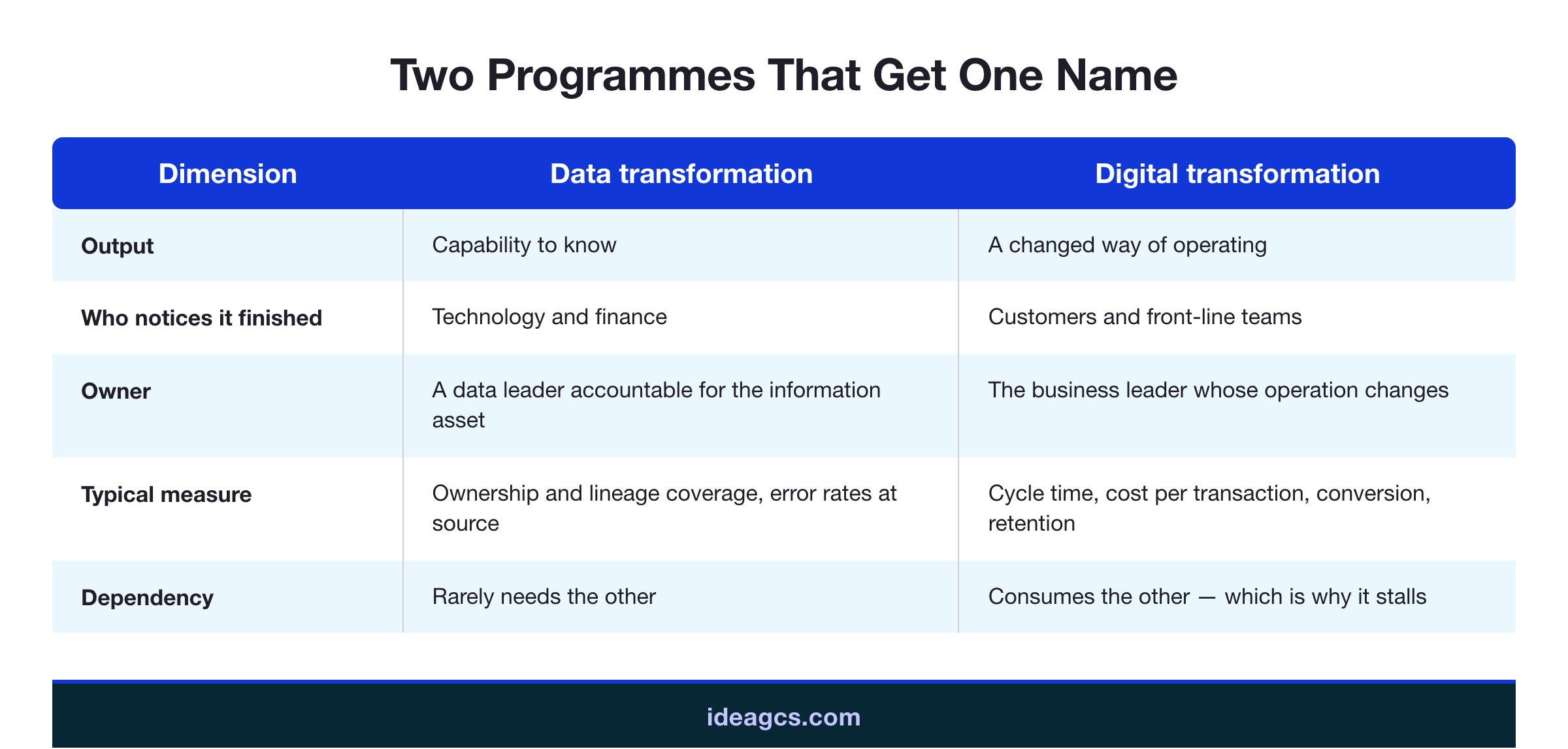
Its output is capability to know. Nobody outside the technology and finance functions experiences it directly, and its benefit is realised only when something else uses it.
Digital transformation is work on how the organisation operates. Changing how a customer buys, how a claim is handled, how an order reaches a warehouse, how a decision gets made and by whom. It usually involves new interfaces, changed processes, and different roles.
Its output is a changed way of working. It is visible, it is what executives can point to, and it is what business cases are written about.
The relationship is directional. Digital change consumes data; data work rarely consumes digital change. That is why one so often blocks the other, and almost never the reverse.
Why They Get Confused
Three reasons, and each one is structural rather than a matter of sloppy language.
Funding. Data work is hard to fund on its own because its benefit is indirect. So it gets attached to a digital programme with a visible business case, and thereafter both are described with one word. The data work is then judged against the digital programme's measures, which it cannot move directly.
Vendors. Suppliers sell to whichever budget exists. A data platform is positioned as digital transformation because that is where the money is; a process-change programme is positioned as data-driven because that is what sounds rigorous. The language follows the budget rather than the work.
Genuine overlap. Real programmes contain both. A customer portal needs a resolved customer record. Automated claims handling needs claims data that is trustworthy. The overlap is real; the error is treating the two halves as one workstream with one owner and one measure.
The Cost of Getting It Wrong
Digital programmes stalling on data. The single most common pattern. Six months in, the portal cannot show a unified customer view because three systems hold different versions of the customer. The programme now has an unbudgeted data workstream, a slipped date, and a sponsor whose confidence is spent.
Data platforms with no consumer. The mirror image. A warehouse or lakehouse is delivered, correctly, and nothing uses it because no operational change was funded to consume it. It is a genuine asset and an unrealised one, and it is very hard to fund a second phase after the first showed no business result.
Measurement mismatch. Data work judged on revenue, or digital change judged on data quality scores. Both look like failure, and both distort the next round of decisions.
Ownership confusion. A single owner made accountable for both usually favours the visible half, and the invisible half is where the dependency lives. Our assessment of what an ageing estate costs covers the version of this that shows up as legacy debt.
Sequencing: The Rule That Works
The instinctive answers are both wrong. "Data first, then digital" produces a long invisible programme that loses its sponsor. "Digital first, fix data later" produces the stall described above.
The rule that works is narrower: do enough data work to unblock the first digital increment, then do both in parallel, each pulled by the next increment.
In practice that means choosing the first operational change, working backwards to the specific data it requires, and doing exactly that data work — not the enterprise-wide version of it. If the first increment is a unified customer view in a service portal, resolve customer identity across the three systems that portal touches. Not all systems. Not all entities.
This has two advantages. The data work has a consumer from day one, so it is validated by use rather than by assertion. And each increment funds the next, because the business result is visible.
The discipline it requires is resisting the architecturally correct instinct to solve the general problem. The general problem gets solved incrementally, by repetition, with each pass shaped by real usage. That is slower on paper and faster in practice. The wider framing is in our framework for transformation that produces evidence.
Two Owners, Two Sets of Measures
Data work should be owned by someone accountable for the information asset — a data leader, a chief data officer, or an equivalent. Its measures are internal and specific: proportion of critical data elements with a defined owner, lineage coverage for regulatory reporting, error rates at source, time to answer a data question that requires joining two systems.
Digital change should be owned by the business leader whose operation is changing. Not by technology. Its measures are operational and commercial: cycle time, cost per transaction, conversion, retention, straight-through processing rate.
The two owners share one plan and one dependency map. The dependency map is the artefact that keeps them honest — it makes explicit which digital increment depends on which piece of data work, so that a slip on either side is visible immediately rather than at integration.
IdeaGCS covers the information side through its data and machine learning services and the operational side through its modernisation engineering services, with the integration layer between them typically the binding constraint.
A Practical Test
If you are unsure which one a proposed piece of work is, three questions settle it.
Who notices when it is finished? If the answer is only technology and finance, it is data work. If a customer or a front-line team notices, it is digital change.
What does it enable versus what does it change? Data work enables something else. Digital change is the something else.
How would you prove it worked? Data work proves itself through capability measures — coverage, quality, time to answer. Digital change proves itself through operational and commercial measures.
Work that cannot be classified by these questions is usually two pieces of work described as one, which is exactly the condition this article is about.
Conclusion
Data transformation changes what an organisation can know. Digital transformation changes how it operates. The first enables the second, the second rarely enables the first, and that asymmetry is why data dependencies stall digital programmes rather than the other way round.
Fund them separately, own them separately, measure them separately, and sequence them together — enough data work to unblock the next operational increment, no more, with a shared dependency map making the couplings visible. Programmes run this way stop producing the two familiar failures: the portal waiting on a customer record, and the data platform nobody uses. Talk to IdeaGCS if you want the dependency map built before the next phase is funded.
Frequently Asked Questions
What is the core difference between the two?

Which should come first?
Why do digital programmes stall on data?
Why is data work hard to fund on its own?
Can one person own both?
How should each be measured?
What is a data platform with no consumer?
How do we avoid over-engineering the data work?
How can we tell which type a proposed project is?
Where does integration fit between the two?
Contact Us
Share on Social Media
Contact Us