In-House Help Desk or Outsourced? A Cost Comparison That Holds Up

Service desk outsourcing decisions are usually made on a per-ticket comparison, and per-ticket cost is the least informative number available. It ignores the coverage commitment that drives the staffing model, it ignores the escalation capability behind the desk, and it treats every ticket as equivalent when a password reset and a failed payment run are not.
This sets out a comparison that holds up: what each side genuinely costs, where the step changes are, and the two failure modes that make the cheaper option turn out to be the more expensive one.
Key Takeaways
- Coverage window, not ticket volume, is what makes a service desk expensive.
- An internal desk below roughly six or seven people cannot sustain continuous coverage without unacceptable strain.
- Outsourced desks are efficient at volume and weak at context — the trade is speed and cost against knowing your estate.
- Escalation capability is the part most often missing from both models and the part that decides user experience.
- Hybrid arrangements work well and need the boundary and the knowledge flow governed explicitly.
What an Internal Desk Actually Costs
Start with fully loaded staff cost, then add the lines that only exist because the function is internal.
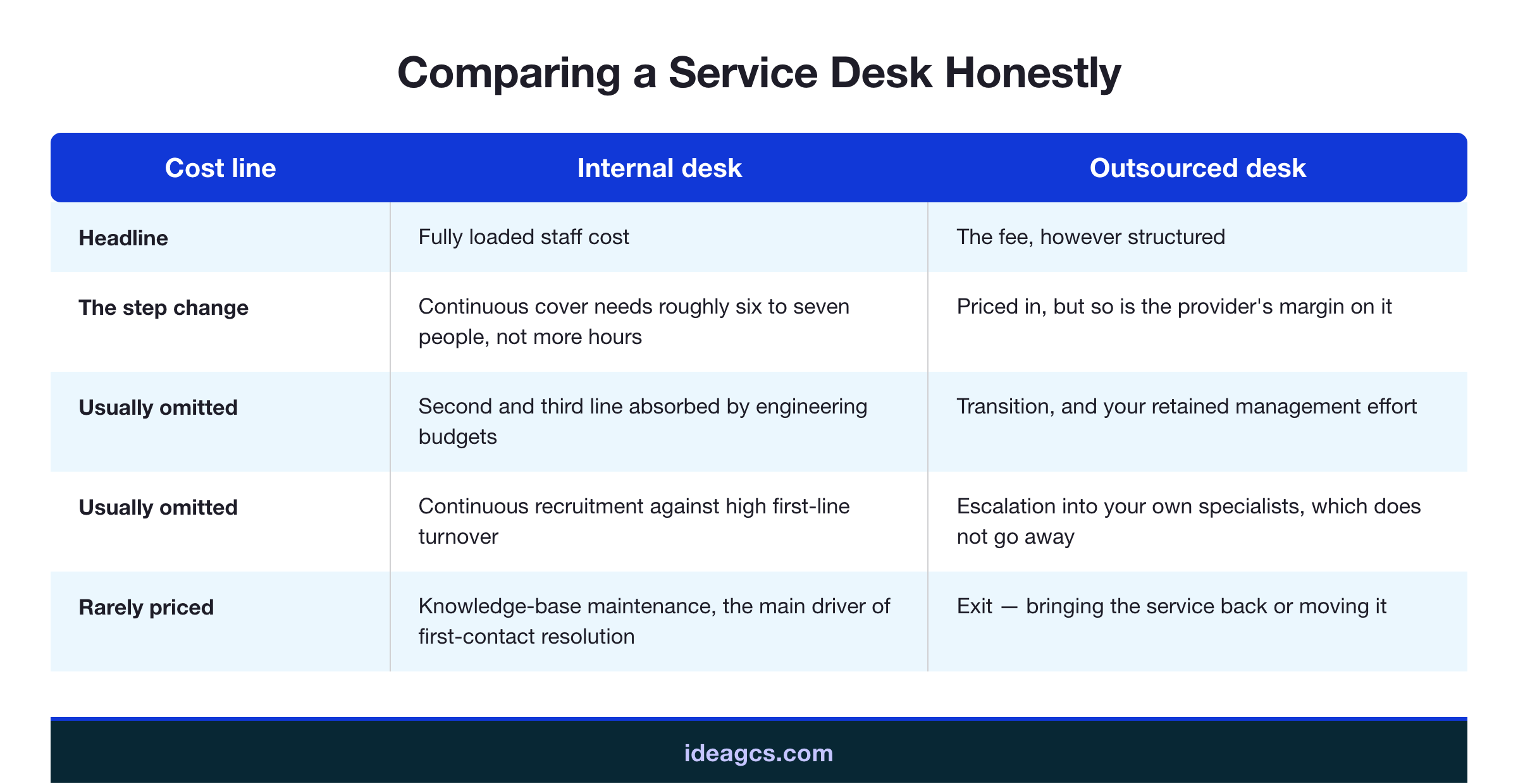
Coverage arithmetic. Business-hours coverage in one geography requires enough people to handle peak concurrent demand plus absence cover. Continuous coverage in the same geography requires a rota, and the minimum sustainable rota is larger than most planning assumes — somewhere around six to seven people to cover continuously with leave, sickness and training accounted for. This is the single largest step change in the model, and it is why small internal desks either do not offer continuous cover or offer it through informal on-call that burns people out.
Tooling. A service management platform, telephony, remote access, knowledge base, asset management. Per-seat licensing at small scale is comparatively expensive.
Management and quality. A team lead, quality sampling, and someone maintaining the knowledge base. The knowledge base is invariably under-resourced and is the main determinant of first-contact resolution.
Recruitment and attrition. First-line support roles turn over quickly across the industry. Budget continuous recruitment and continuous ramp rather than treating both as one-off.
Escalation. Second and third line are frequently engineers whose main job is something else, and the desk consumes their time in interruptions. This cost is real and almost never allocated to the desk in internal accounting, which flatters the internal option substantially.
What an Outsourced Desk Actually Costs
The fee, however structured — per seat, per ticket, per user, or fixed capacity. Each shape creates a different incentive, and per-ticket pricing in particular rewards ticket volume rather than problem elimination.
Transition. Knowledge capture, documentation, tooling integration, and a parallel period. Substantial, one-off, and frequently under-quoted by both parties.
Your retained team. Someone must manage the provider, own the service definition, and act as the escalation route into your own engineers. Outsourcing the desk does not outsource the accountability, and this role is not junior.
Escalation into your specialists. The provider handles first line and possibly second; your engineers still take the deep issues. This cost persists in both models and is often presented as a saving in the outsourced case, which it is not.
Exit. What it costs to bring the service back or move it. Worth pricing at signature even if you never use it.
Where the Comparison Usually Goes Wrong
Comparing per-ticket cost. It ignores coverage, escalation, and ticket mix. A desk handling straightforward requests cheaply looks efficient until the complex tickets arrive and are all escalated.
Omitting internal escalation. The largest single distortion. When second-line effort is absorbed by engineering budgets rather than charged to the desk, the internal option looks materially cheaper than it is.
Ignoring the coverage step change. Modelling continuous coverage as a linear extension of business-hours staffing understates the internal cost badly, because it is a different staffing model rather than more of the same one.
Assuming outsourcing removes management effort. It changes it. A well-managed outsourced desk requires meaningful ongoing effort from someone senior enough to hold the provider to account.
The Two Real Failure Modes
Internal desks that cannot scale coverage. A capable internal team, well-liked by users, offering business-hours support with informal out-of-hours cover through a handful of goodwill volunteers. It works until the volunteers leave, and the organisation discovers it never had a continuous service — it had an arrangement.
Outsourced desks with no estate knowledge. Tickets are answered promptly, routed correctly by process, and escalated for anything requiring context. Metrics look strong; user satisfaction is poor. The provider is doing exactly what was contracted, and what was contracted omitted the thing that mattered.
The second failure is preventable and rarely prevented. The mitigations are known: a defined knowledge-transfer period with the outgoing team engaged, a jointly-owned knowledge base with contractual quality requirements, provider staff embedded on site during transition, and low provider-side turnover written into the arrangement.
Hybrid Arrangements
The shape many organisations settle on: an outsourced first line handling volume and coverage, with an internal second line holding estate knowledge and specialist capability.
This gets the economics of scale where volume justifies them and keeps context where context matters. It requires two things to be governed.
The boundary. What the provider resolves and what it escalates, defined by capability and category rather than by elapsed time. Time-based escalation produces tickets thrown over the wall at the deadline.
Knowledge flow. Both directions. The provider needs estate knowledge to resolve more; your team needs visibility of incoming patterns to remove causes. A shared knowledge base with obligations on both sides is the mechanism, and it needs an owner or it decays.
Our pillar guide to staffing and support sets out how the two functions are scoped together rather than sequentially.
Deciding
Four questions settle most cases.
What coverage do you genuinely need? Test it against actual out-of-hours incident volume rather than against a policy statement. Continuous cover for systems whose users are asleep is a common and expensive default, and reviewing it frequently releases budget.
How specialised is your estate? Highly bespoke estates are expensive for a provider to learn and favour internal or hybrid arrangements. Standard estates outsource well.
What is your ticket mix? Volume-heavy and simple favours outsourcing. Low-volume and complex favours internal, because the economics of scale do not apply and context does.
Is user experience a differentiator? In some organisations the service desk is a visible part of the employee proposition. That is a legitimate reason to keep it internal even where the model says otherwise — but it should be a stated choice rather than an unexamined assumption.
Measuring Either Model
Track resolution time by severity, first-contact resolution rate, repeat-incident rate, and user satisfaction sampled independently rather than solicited at ticket closure.
Repeat-incident rate is the measure worth watching hardest, because it distinguishes a desk that closes tickets from one that removes causes — and it is the number that predicts next year's volume. A desk with excellent resolution times and a rising repeat rate is heading somewhere expensive.
Also track the proportion of tickets escalated beyond first line. It is the clearest indicator of whether the front line has the knowledge to do its job, and it is the number that moves when knowledge transfer is working.
Conclusion
Compare on total cost of the service, with coverage modelled as the step change it is and internal escalation charged where it belongs. Done properly, the two options are usually closer than the per-ticket figures suggest, and the decision turns on estate specificity and ticket mix rather than on price.
Whichever model, the deciding factor for users is escalation capability and estate knowledge — the parts both models most often leave underspecified. Govern the boundary, own the knowledge base, and measure the repeat-incident rate. Talk to IdeaGCS if you want the model run against your own volumes and coverage.
Frequently Asked Questions
What makes a service desk expensive?

How many people does an internal desk need for continuous coverage?
Why is per-ticket cost a poor basis for comparison?
What is the biggest distortion in these business cases?
Does outsourcing remove management effort?
What goes wrong with outsourced desks?
How should a hybrid boundary be defined?
What should be measured?
Why does repeat-incident rate matter so much?
When should a desk stay internal despite the cost?
Contact Us
Share on Social Media
Contact Us