Beyond the Buzzword: What Transformation Advisory Actually Delivers in the First 90 Days
"Advisory" is the vaguest word in enterprise technology procurement, and the vagueness is commercially convenient for the people selling it. A buyer who cannot describe what they will receive cannot tell whether they received it.
This sets out what a competent advisory engagement actually produces in its first quarter — week by week, with the artefacts named — and what it looks like when one is going nowhere. It is written so a buyer can hold an engagement to it.
Key Takeaways
- Weeks one to three produce a factual estate picture that usually contradicts what leadership believed.
- The measurement baseline has to be captured in the first month or it cannot be captured at all.
- By week six there should be a sequenced plan with dependencies and a named first delivery, not a list of initiatives.
- The engagement ends in decisions with owners and dates, not in a document.
- The clearest warning sign is week eight with no findings that surprised anyone.
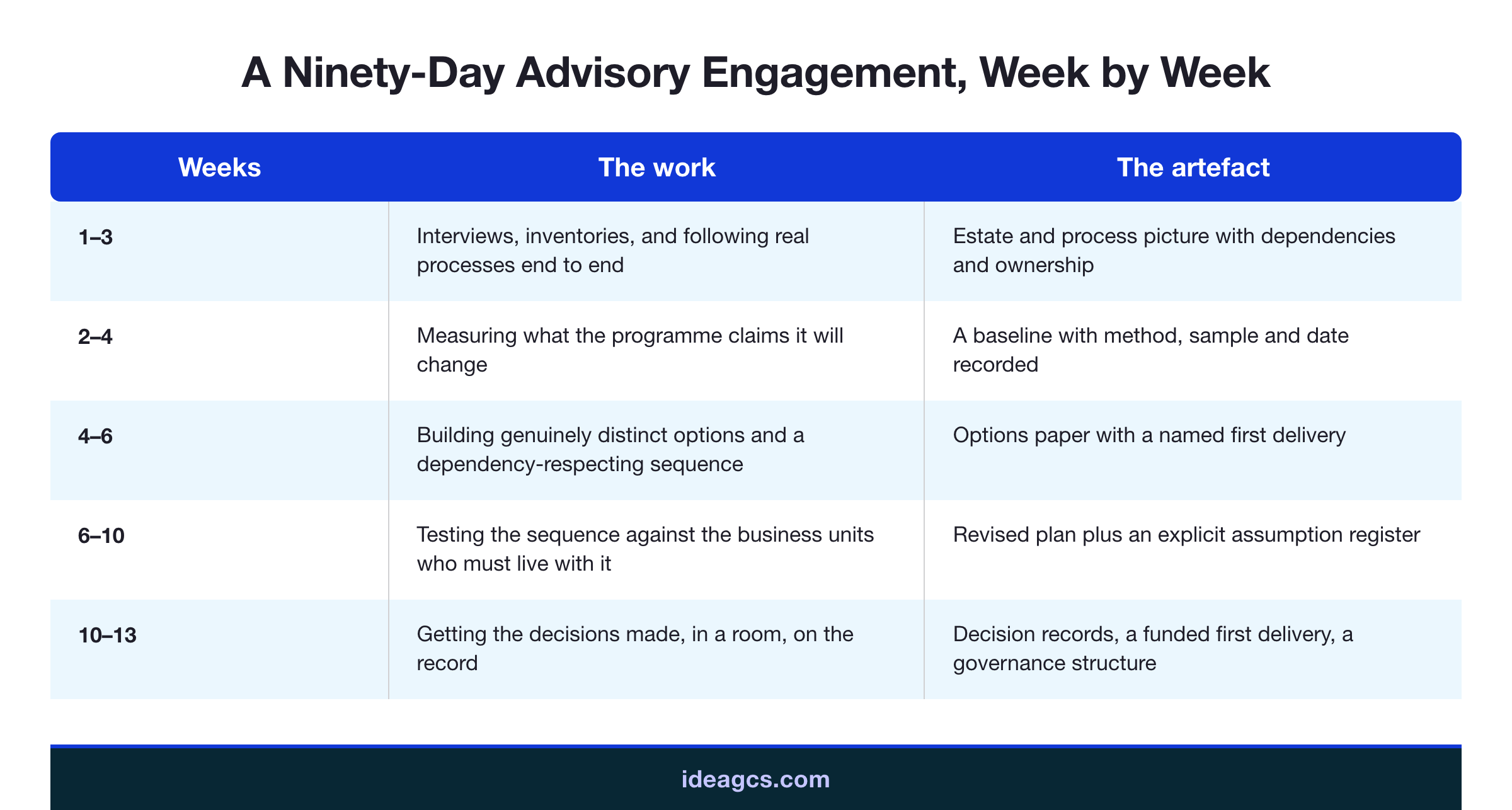
Weeks 1–3: The Factual Picture
The first task is establishing what is actually there, and it is more revealing than it sounds. In most enterprises no single person holds a complete picture of the estate — what systems exist, what they cost, what depends on what, where data is mastered, and which processes are genuinely manual.
The work is unglamorous: interviews across business and technology, system inventories, contract and licence reviews, and following two or three end-to-end processes from initiation to completion, in reality rather than as documented. That last exercise produces most of the value. The gap between the documented process and the observed one is where the cost sits.
The artefact: a system and process inventory with dependencies, costs, and ownership, plus a written summary of where the observed reality differs from the documented one.
The signal it is working: leadership is surprised. If a competent three-week diagnostic tells the executive team nothing they did not know, either the organisation is unusually well-run or the work was superficial. In practice it is nearly always the latter.
Weeks 2–4: The Baseline
This runs in parallel and it is the step most often skipped, because it feels like measurement rather than progress.
Whatever the programme claims it will improve, measure it now. Cycle times end to end. Error and rework rates. Cost per transaction. Hours spent on the work that is proposed for automation. Conversion, retention, or whatever commercial number is in the case.
Measured, not estimated. A number produced in a workshop is a recollection. Sampling actual cases, or instrumenting the system, produces something that can be repeated in twelve months and compared.
The artefact: a baseline document with each number, the method used to obtain it, the sample, and the date.
Why the window is narrow: once change begins, the pre-change state is gone. A baseline reconstructed later is an estimate dressed as evidence, and it will not survive scrutiny when the benefit claim is made.
Weeks 4–6: Options and Sequencing
With facts and a baseline, the work turns to what to do and in what order.
The valuable output here is not a recommendation. It is a small number of genuinely distinct options, each with its cost, its dependencies, its risks, and what it forecloses. Three or four is usually right — fewer suggests the analysis was thin, more suggests it was not done.
Sequencing is where the judgement concentrates. Some things must precede others for hard dependency reasons: data quality before analytics, integration before cross-system process automation, identity before self-service. Other orderings are matters of evidence and momentum — what should be delivered first so the programme earns its next tranche of confidence.
The first delivery should satisfy two conditions: it matters to the business, and it can fail without endangering anything. Almost every estate has a candidate, and finding it is a large part of what the engagement is for.
The artefact: an options paper with a sequenced plan, dependencies made explicit, and a named first delivery with a scope.
Weeks 6–10: Testing It Against Reality
An untested plan is a hypothesis. This phase pressure-tests it against the people who will have to live with it.
That means taking the sequence to the business units affected and finding out what breaks. Constraints emerge here that no inventory reveals: a seasonal freeze nobody mentioned, a regulatory deadline that consumes the same team, a supplier contract with a notice period that changes the sequence, a business unit part-way through its own initiative that overlaps.
It also means testing the assumptions. Every plan rests on things assumed to be true — that a system's data is accessible, that a team has capacity, that a vendor will cooperate. The high-consequence assumptions should be checked now rather than discovered in delivery.
The artefact: a revised plan with constraints incorporated, and an explicit assumption register recording what was tested and what remains unverified.
The signal it is working: the plan changes. A sequence that survives contact with the business units unaltered was not tested.
Weeks 10–13: Decisions
The engagement should end in decisions, not in a document. The decisions were named at scoping; now they have evidence attached, and someone has to make them.
Each decision needs a named owner with the authority to make it, the evidence supporting each option, a recommendation with reasoning, and a date. Getting them made — actually made, in a meeting, recorded — is part of the engagement rather than something that happens afterwards.
The artefacts: a decision record for each; a funded and scoped first delivery ready to start; and a governance structure naming who owns the programme, who owns the architecture, and how progress will be reported.
An engagement that ends with a well-written strategy document and no decisions has not finished. It has produced an input to a decision that nobody has taken responsibility for, which is how strategy documents come to sit unread.
Warning Signs
Week eight and nothing has surprised anyone. The single clearest indicator of a superficial engagement.
No baseline. If it was not measured in the first month it will not be measured, and the programme will be unevaluable.
Deliverables that are decks rather than findings. Volume of output is not correlated with usefulness and is often inversely related.
A plan that has not changed since week six. It has not been tested.
No named decision owners. The engagement will end without decisions.
Staffing that does not match the pitch. The most common structural complaint in this market, and it is visible by week two if you look at who is actually in the room. Our red flags and green lights for choosing an advisory partner covers how to contract against it.
What Should Not Be Expected
Three things buyers reasonably want and should not expect from a first quarter.
A complete plan for three years. Anything beyond the first two or three increments is a placeholder, and treating it as a commitment produces a plan that has to be defended rather than adapted.
Precise costs for later phases. Costs are estimable to a useful range for work that is specified and to nothing better than an order of magnitude for work that is not.
Delivered change. Ninety days of advisory produces the conditions for delivery. Any material operational improvement inside the window either came from something already underway or was very small.
Expecting these produces disappointment with engagements that actually went well, which is its own kind of expensive.
Conclusion
A competent advisory engagement produces four things in ninety days: a factual estate picture that contradicts some of what leadership believed, a measured baseline captured before anything changed, a sequenced plan tested against the business units and revised as a result, and decisions with named owners and dates.
Buyers who write those four artefacts into the scope get engagements that produce them. Buyers who write "strategy and roadmap" get a document. The difference is set at contracting, not at delivery. Talk to IdeaGCS if you want an engagement scoped against these artefacts.
Frequently Asked Questions
What should an advisory engagement produce in its first quarter?

Why is the baseline so time-critical?
What is the clearest sign an engagement is superficial?
Should the plan change during the engagement?
How many options should be presented?
What makes a good first delivery?
Should we expect delivered change in ninety days?
How precise should later-phase costs be?
What does a decision record need to contain?
How do we prevent the staffing bait-and-switch?
Contact Us
Share on Social Media
Contact Us