Digital Transformation in Banking: A Compliance-First Implementation Playbook

Most writing about modernisation in banking stops at the trends. This does not. It assumes the decision to modernise is made and addresses the harder question: how to sequence and govern the work so that the compliance obligations which apply throughout are designed in, rather than discovered by an examiner afterwards.
The distinction between banks that do this well and badly is rarely technical capability. It is whether the control design happened at the start, when it was cheap, or at the end, when it is not.
Key Takeaways
- Regulatory obligations do not pause during a programme; the estate must remain evidenceable throughout, not only at the end.
- Data lineage is the constraint most often discovered late and the most expensive to retrofit.
- Operational resilience requirements make dual-running a control, not just a migration technique.
- Change management in banking is an audit artefact — the pipeline is evidence, and it should be designed as such.
- Third-party and concentration risk shape which suppliers and which architectures are actually available to you.
Start From the Obligations, Not the Architecture
The conventional sequence designs the target architecture and then asks compliance to review it. That produces a review that either rubber-stamps or blocks, neither of which is useful.
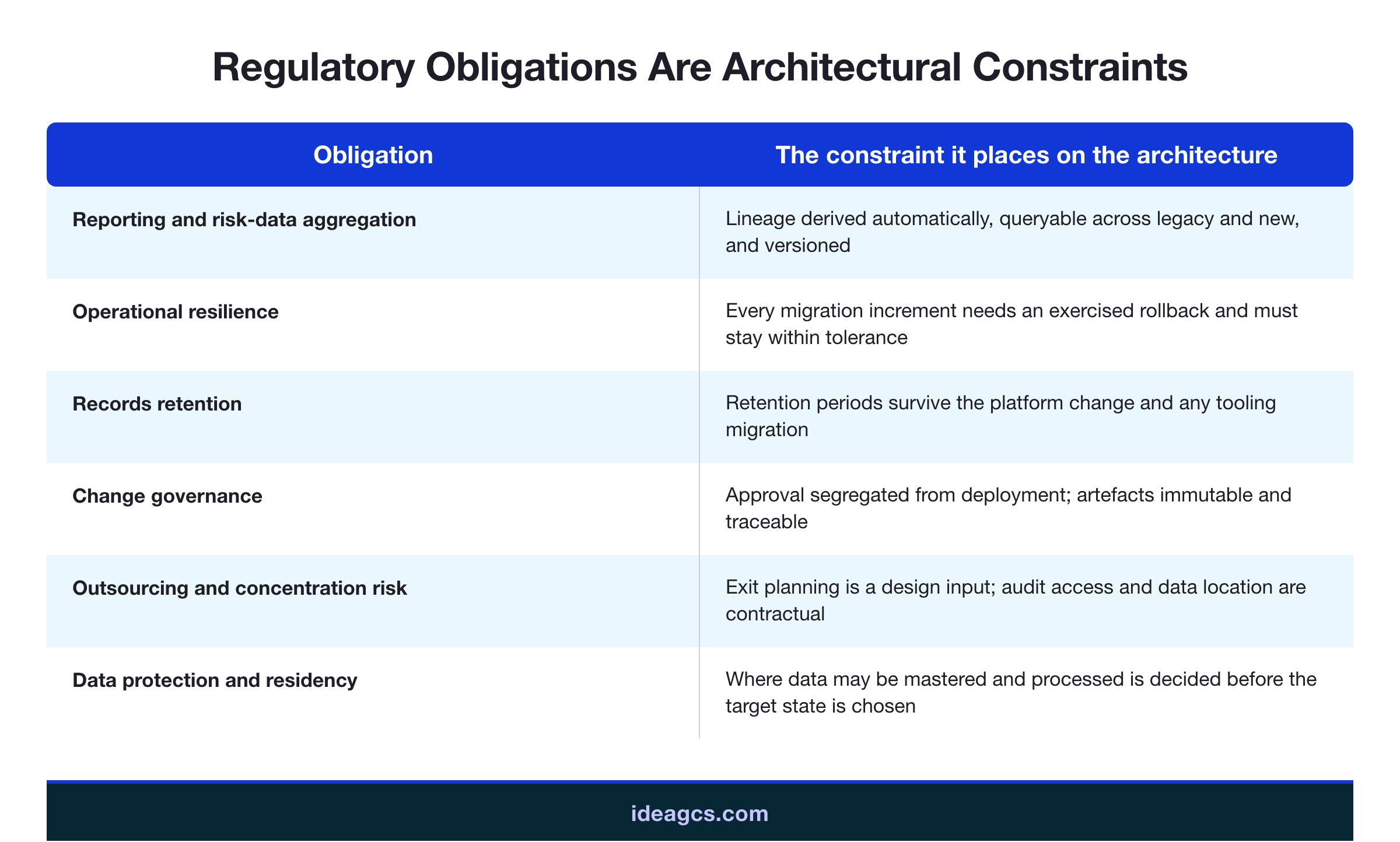
The workable sequence inverts it. Establish, at the start, which obligations apply to the systems in scope and what evidence each requires. Regulatory reporting and the lineage required to support it. Customer data protection and residency. Operational resilience and the tolerances set for important business services. Records retention with its stated periods. Model governance where decisions are model-driven. Outsourcing and third-party risk requirements.
Each of these places a constraint on architecture, and most are cheap to satisfy by design and expensive to satisfy by remediation. A bank that knows before choosing a target state that a particular reporting stream requires demonstrable lineage will make different decisions about where data is mastered — and will not discover the problem after the platform is built.
Data Lineage Is the Binding Constraint
Of all the obligations, lineage catches the most programmes late.
Supervisory expectations on risk data aggregation and reporting require a bank to demonstrate where a reported figure came from — the source system, the transformations applied, the controls at each step. In a legacy estate this is usually documented rather than derived, and the documentation has drifted. During a modernisation, lineage has to hold across both old and new components simultaneously, which is a harder problem than either alone.
Three design decisions follow. Capture lineage automatically as part of data movement rather than maintaining it as documentation, because documentation drifts and derived lineage does not. Keep it queryable across the boundary between legacy and new, since during transition a single figure may traverse both. And version it, so a figure reported two years ago can be explained against the transformations in force then, not the ones in force now.
Retrofitting this onto a completed migration is among the more expensive remediation exercises in the sector, and it is entirely avoidable. The general pattern of decoupling systems so data movement is observable is covered in our walkthrough of layered API design.
Resilience Changes How You Migrate
Operational resilience regimes require banks to identify important business services, set tolerances for disruption, and demonstrate they can stay within them under severe but plausible scenarios.
For a modernisation programme this has a direct consequence: any migration touching an important business service must be able to demonstrate it stays within tolerance during the migration itself, not merely after it. That reframes dual-running from a prudent technique into a control with an evidential purpose, and it makes the rollback path something to be tested and documented rather than assumed.
Practically, three things follow. Migration plans need a demonstrated rollback for each increment, exercised rather than described. Increments should be sized so that the failure of any single one stays within tolerance. And the scenario testing that the regime requires should include the transition state, because a bank running two systems in parallel has a different failure profile from one running either alone.
The Pipeline as Audit Evidence
In banking, how changes reach production is itself subject to examination. Who approved a change, what testing ran, what was scanned, and whether the artefact deployed is the one that was tested are all questions with regulatory weight.
A manual change process answers these badly — through forms, tickets, and recollection assembled after the fact. A well-designed pipeline answers them as a by-product.
Four controls carry most of the load. Approval must be segregated from deployment as a permissions boundary rather than a meeting. Artefacts must be immutable and traceable by digest to the commit that produced them, so "is production running what was tested" is a comparison rather than an assurance. The pipeline's own actions must log to a store the pipeline cannot rewrite. And retention must be set against the regulatory window rather than the tool's default, surviving any subsequent tooling migration.
Banks that build this early find examination preparation stops being a multi-week project each cycle. Those that do not carry that cost indefinitely.
Third-Party and Concentration Risk
Outsourcing rules shape which suppliers are genuinely available and constrain the architecture more than most technology teams expect.
Material outsourcing arrangements carry due diligence, contractual, audit-access and exit-planning obligations. Cloud concentration attracts specific supervisory attention, and a bank's ability to demonstrate it could exit or substitute a critical provider is a live question rather than a theoretical one.
Two implications for a modernisation programme. First, exit planning is a design input, not a contractual afterthought — an architecture that cannot be exited is a supervisory issue regardless of how well it performs. Second, supplier selection has a compliance dimension alongside the commercial one: audit access rights, sub-outsourcing transparency, and data location commitments all need to be present in the contract, and adding them later is difficult.
This is one reason many banks favour arrangements where the pipelines, infrastructure definitions and operational knowledge remain the bank's own property rather than a supplier's platform — the exit question answers itself.
Sequencing a Bank's Estate
The pattern that works is the same one that works in insurance and healthcare, with tighter evidence requirements at each step.
Start away from the regulated core. Internal tooling, staff-facing systems, non-customer-facing reporting. Build the full control pattern here — approval segregation, lineage capture, evidence retention — and get it accepted by internal audit before it is needed on something critical.
Move to customer-facing systems that do not master regulated data. Portals, servicing interfaces, communications. Disruption here is visible but does not touch the record of truth.
Then the data layer. Reporting, lineage, and the systems that master customer and account data. This is where the lineage work has to be right, and it benefits from being done after the control pattern is proven.
The core last, or behind an interface. Core banking replacement is a decade-scale commitment for a large institution. Many banks find that once reporting, channels and integration have moved, the residual core is stable enough to sit behind an API boundary indefinitely — a legitimate outcome rather than a failure to finish. Our modernisation path for carriers sets out the equivalent sequence in insurance.
Throughout, the operational calendar constrains delivery: period end, regulatory reporting windows, and audit cycles are fixed points that the plan is built around rather than through.
Governance That Satisfies Both Sides
The recurring tension is between delivery pace and control assurance, and it is usually managed badly in both directions — either a change board that reviews every deployment individually, or an engineering function that treats governance as an obstacle.
The resolution is to govern the pattern rather than the instance. The control design — how approval works, how evidence is captured, how retention is enforced — is reviewed and approved once, thoroughly. Individual changes that conform to the approved pattern then flow without a separate review, and the assurance activity becomes sampling and monitoring rather than gate-keeping.
This requires internal audit and technology risk to be involved in the design phase rather than the review phase, which is a change in working practice more than in tooling. It is also the single highest-return governance change available to most banks running modernisation programmes. The wider engineering context sits in our enterprise guide to delivery automation and cloud operations.
Conclusion
The banks that modernise well are not the ones with better architecture. They are the ones that started from the obligations, designed lineage and evidence capture in at the beginning, treated dual-running as a resilience control rather than a convenience, and moved their governance function from reviewing changes to approving the pattern that produces them.
Sequence away from the regulated core outward, build the control pattern where a mistake is survivable, and get internal audit's acceptance before you need it. The programme takes longer than an unconstrained plan claims and considerably less long than a remediation exercise after an examination finding. Talk to IdeaGCS if you want a sequence built around your own obligations.
Frequently Asked Questions
Where should a bank start a modernisation programme?

What is the most expensive thing to retrofit?
How does operational resilience affect a migration plan?
Why does the deployment pipeline matter to compliance?
Do we have to replace the core banking system?
How do outsourcing rules constrain architecture?
How should change governance work during modernisation?
When should internal audit be involved?
How do regulatory calendars affect delivery?
What does lineage need to support that documentation does not?
Contact Us
Share on Social Media
Contact Us