2027 IT Budgets: Why Data Infrastructure Is Winning Over New AI Tool Spend

Worldwide IT spending is on course to reach $6.31 trillion in 2026, and the latest Gartner forecast reported by Help Net Security shows data centre systems growing 55.8%, far ahead of every other segment. That signal matters for AI budget planning 2027 enterprise leaders are starting now. The money is moving toward the foundations that make AI work, not only toward the next tool licence.
If you are building next year's plan in the UAE, Saudi Arabia or the wider GCC, it helps to test your assumptions early. You can talk to the IdeaGCS team about where your data estate stands before new contracts are signed. This guide explains why infrastructure is winning the budget argument, what the research says about AI returns, and how to split spend sensibly for 2027.
Key Takeaways
- Global and regional forecasts both put data centre and data infrastructure spending ahead of software growth, which tells CIOs where the real constraints sit.
- Most organisations still lack confidence in their data management for AI, so new AI tools often stall without cleaner, connected data underneath.
- A defensible plan for AI budget planning 2027 enterprise boards will approve puts data readiness first and scales AI tools only once they prove value. Choosing a data consulting company for a 2027 roadmap in the GCC starts with that sequence.
What the 2026 Forecasts Say About Where IT Money Is Going
Summary: The largest forecasters agree on direction. Infrastructure spending is growing faster than software, and AI workloads are the main reason. For budget holders, that means the cost of running AI well is landing in data platforms, compute and integration, not just in subscriptions.
Gartner expects worldwide data centre spending to climb from about $506 billion in 2025 to about $788 billion in 2026. Software is forecast to grow 15.1%, and IT services should pass $1.87 trillion. Gartner's John-David Lovelock described the forecast as underscoring "the accelerating momentum in AI infrastructure."
The pattern is similar closer to home. A Gartner forecast for the Middle East and North Africa projects regional IT spending of $169 billion in 2026, up 8.9%. Data centre systems are the fastest growing segment at 37.3%, reaching $13 billion. Software grows 13.9% and IT services 8.3%.
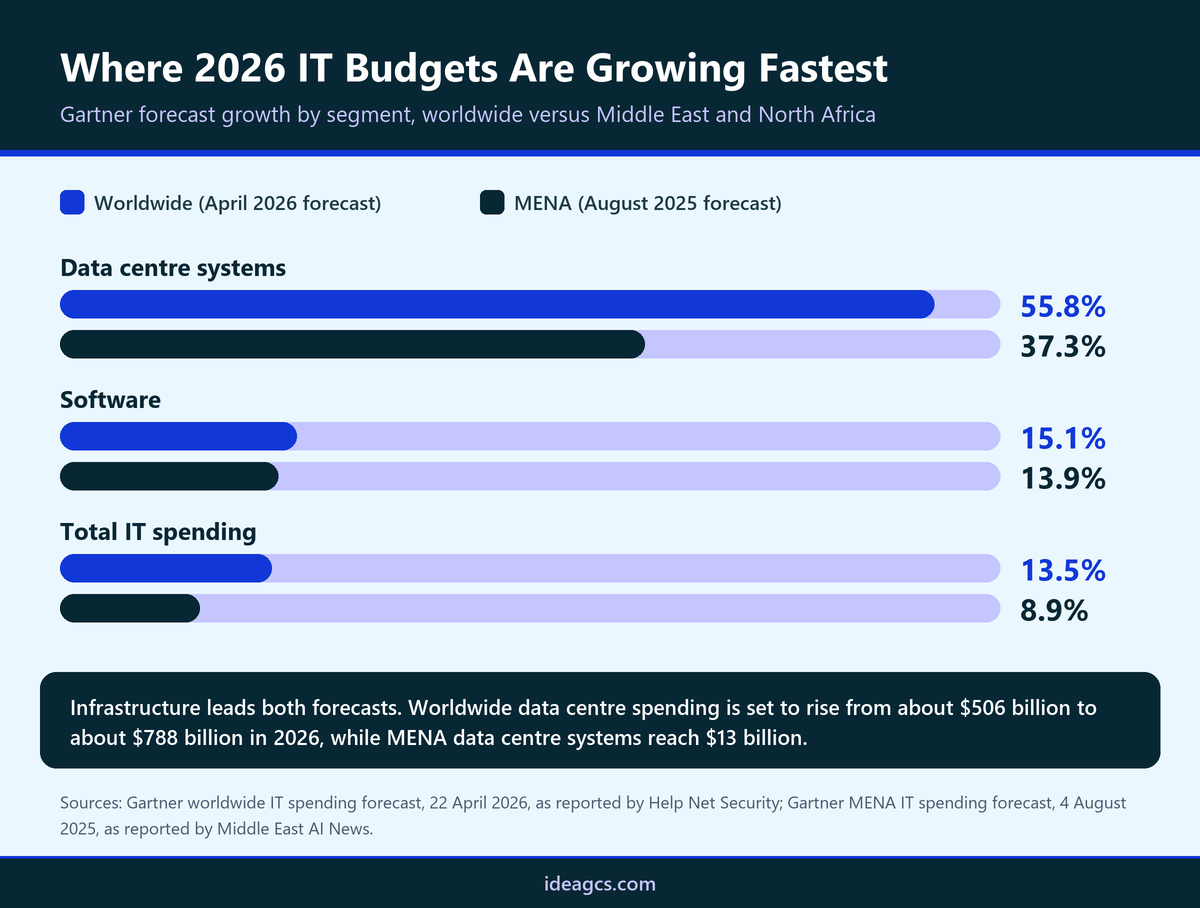
Read together, these numbers point one way. Enterprises are paying to build the platforms that AI depends on, before they pay for more tools to sit on top.
There is a pricing angle too. Lovelock noted that strong demand and supply constraints have pushed high bandwidth memory prices to record increases. Infrastructure is getting more expensive, so every dirham or riyal spent on compute needs clean, useful data flowing through it. Idle capacity fed by poor data is the costliest line in any AI budget.
Why New AI Tools Disappoint Without Data Foundations
Summary: AI tools are only as useful as the data they can reach. When records are siloed, inconsistent or poorly governed, even capable tools produce unreliable answers. That is why many pilots never reach production and why data work is absorbing a larger share of budgets.
Gartner research shows the scale of the gap. A survey conducted in July 2024 found that 63% of organisations lack confidence in their data management practices for AI. Gartner also predicts that 60% of AI projects lacking AI ready data will be abandoned by 2026.
Regional AI spending is still climbing fast. An IDC forecast for the Middle East, Turkiye and Africa puts AI spending at $7.2 billion in 2026, growing at a 37% compound annual rate. Rising spend combined with weak data foundations is exactly how budgets get wasted.
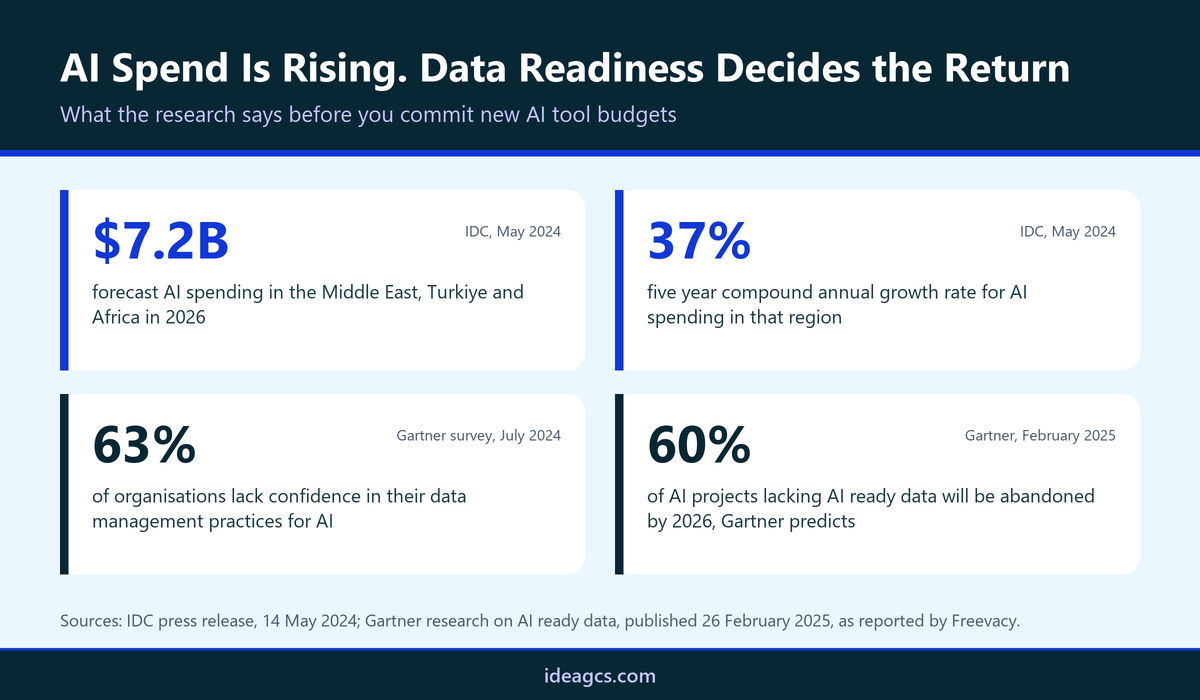
The practical lesson is simple. A new AI tool cannot fix duplicated customer records, disconnected ERP instances or missing data ownership. Those problems need engineering, integration and governance, which is why a strong data engineering and analytics practice often delivers more value than another licence.
Tool sprawl adds a further cost. Each new AI product brings its own connectors, security reviews and support overhead. When several teams buy overlapping tools, the organisation pays more and still lacks a single trusted view of its data.
The Regulatory Factor for GCC Enterprises
Summary: In the Gulf, data infrastructure decisions are also compliance decisions. Personal data rules, cross border transfer requirements and sector regulators shape where data can live and how it moves. Budgets that ignore these factors tend to face costly rework later.
The UAE Federal Decree Law No. 45 of 2021 on personal data protection sets controls for processing personal data. As the UAE government portal on data protection laws explains, it also sets out requirements for the cross border transfer and sharing of personal data. Free zones such as the DIFC run their own data protection regimes, and health data has its own federal law.
For CIOs, this changes the budget conversation. Hosting choices, data residency, access controls and audit trails all carry cost. A well planned hybrid cloud architecture can keep regulated workloads in the right jurisdiction while still giving AI teams the compute they need. Getting this right once is far cheaper than retrofitting every AI tool later.
Many Gulf groups also run separate systems across several countries, with Arabic and English fields mixed in core records. Each of those conditions is a data infrastructure task that must be solved before AI can deliver trustworthy results.
How to Split Your 2027 Budget Between Data and AI Tools
Summary: A balanced plan funds the data layer first, ties every AI tool to a measurable use case, and releases further spend only when results are proven. This keeps risk controlled and makes the business case easier to defend at board level.
- Start from use cases, not vendors. Pick three priority AI use cases and list the data sources each one depends on.
- Audit data readiness. Score those sources for completeness, freshness, ownership and quality before committing tool spend.
- Fund integration early. An API led integration approach turns fragile point to point links into reusable, governed access to core systems.
- Modernise only what blocks progress. Targeted application modernisation can unlock data from legacy platforms without a full rebuild.
- Automate the pipeline. Mature DevOps automation keeps data and model deployments repeatable, secure and cheaper to run.
- Gate AI tool spend on evidence. Release licences and scale only for use cases where clean data is in place and results are measurable.
This approach mirrors what the forecasts show. Organisations are building the foundations first, because tools placed on weak data rarely earn their cost back.
Choosing the Right Partner for the Work
Summary: Data infrastructure work crosses many systems at once. The right partner combines integration, data engineering, cloud and governance skills, so your teams avoid handoffs between several vendors and keep one accountable plan.
When you assess an AI implementation partner near me for enterprises, look beyond model demos. Ask how they profile data quality, how they integrate ERP and CRM platforms, and how they handle data residency. Ask for a phased plan with clear checkpoints rather than a single large commitment.
IdeaGCS supports enterprises with data engineering, AI powered analytics, machine learning, Power BI dashboards and cloud migration, alongside MuleSoft integration and modernisation. That breadth lets one team connect the data layer to the AI use cases your business actually needs.
A few questions help separate strong partners from tool resellers:
- Can they show how a data readiness assessment translates into a costed, phased roadmap?
- Do they build governance, lineage and access controls into delivery rather than after go live?
- Can they explain how their approach fits UAE data protection rules and your sector regulator?
- Will they help you retire or consolidate tools, not just add new ones?
Clear answers to these questions protect your 2027 budget from the most common sources of waste.
Conclusion
The 2026 forecasts send a consistent message. Data centre and infrastructure spending is outpacing software, regional AI budgets are rising fast, and many organisations still lack confidence in their data. For AI budget planning 2027 enterprise leaders should fund readiness first, connect the silos, respect regional data rules, and scale AI tools only where results are proven. Treat the outlook as a planning guide rather than a guarantee, and revisit it each quarter. When you are ready to pressure test your plan, book a budget planning conversation with our team.
Frequently Asked Questions
How should enterprises approach AI budget planning 2027 enterprise wide?

Why is data infrastructure getting more budget than new AI tools?
What did Gartner forecast for worldwide IT spending in 2026?
How fast is IT spending growing in the Middle East and North Africa?
What should a data consulting company for a 2027 roadmap in the GCC deliver?
How do UAE data protection laws affect AI and data budgets?
How do I find an AI implementation partner near me for enterprises?
Why do so many AI projects fail to reach production?
Should we cut AI tool spending in 2027?
Do we need new hires to build data infrastructure for AI?
Contact Us
Share on Social Media
Contact Us