What Is RPO? Recruitment Process Outsourcing Explained Simply

What is RPO recruitment, and why are enterprises across the UK, India, US, UAE, and Philippines turning to it instead of traditional hiring? Recruitment process outsourcing is a model in which an organisation transfers all or part of its talent acquisition function to a specialist external partner. The RPO provider acts as an extension of the internal HR team, managing sourcing, screening, interviewing, and onboarding on behalf of the client. This guide explains what RPO is, the models available, and who benefits most from this approach.
Key Takeaways
RPO stands for recruitment process outsourcing, a model where an external specialist manages hiring on behalf of an organisation
RPO providers can take on a full function, selective roles, or project-based hiring depending on the engagement model chosen
IdeaGCS delivers RPO services across the UK, India, US, UAE, and Philippines, covering both technical and non-technical roles
What Is Recruitment Process Outsourcing?
Recruitment process outsourcing is a form of business process outsourcing in which an employer transfers some or all of its recruitment activity to an external provider. The RPO provider typically assumes ownership of the process design, the technology, the sourcing channels, the screening methodology, and the candidate communication throughout the hiring lifecycle. Unlike a staffing agency, which fills individual vacancies on request, an RPO partner integrates into the client organisation and operates as an embedded part of the talent acquisition function.
The defining characteristic of RPO is process ownership. The provider is not simply supplying candidates. It is managing the end-to-end recruitment workflow and held accountable for outcomes including time-to-fill, cost-per-hire, and quality-of-hire metrics. This accountability structure is what distinguishes RPO from ad hoc recruitment support. For organisations experiencing rapid growth, high-volume hiring, or persistent recruitment inefficiency, RPO services from IdeaGCS provide the structure and specialist capacity needed to scale hiring without scaling internal HR headcount proportionally.
The Main Types of RPO Models
Full RPO is the most comprehensive model, in which the provider manages the entire recruitment function across all roles and business units. The client's internal talent acquisition team is effectively replaced or supplemented by the RPO partner operating under the client's employer brand. This model suits large enterprises with consistent, ongoing hiring volumes across multiple locations and role types.
Selective RPO, sometimes called partial RPO, covers specific roles, business units, or geographies while the client retains responsibility for the remainder. On-demand RPO is a project-based model activated for a defined hiring surge, such as a new office opening or seasonal volume spike. Project RPO offers the flexibility of external specialist capacity without a long-term commitment. Each model has different commercial structures, from cost-per-hire fees to retained monthly arrangements. Understanding which model aligns with your hiring profile is the starting point for any RPO evaluation.
How the RPO Process Works End to End
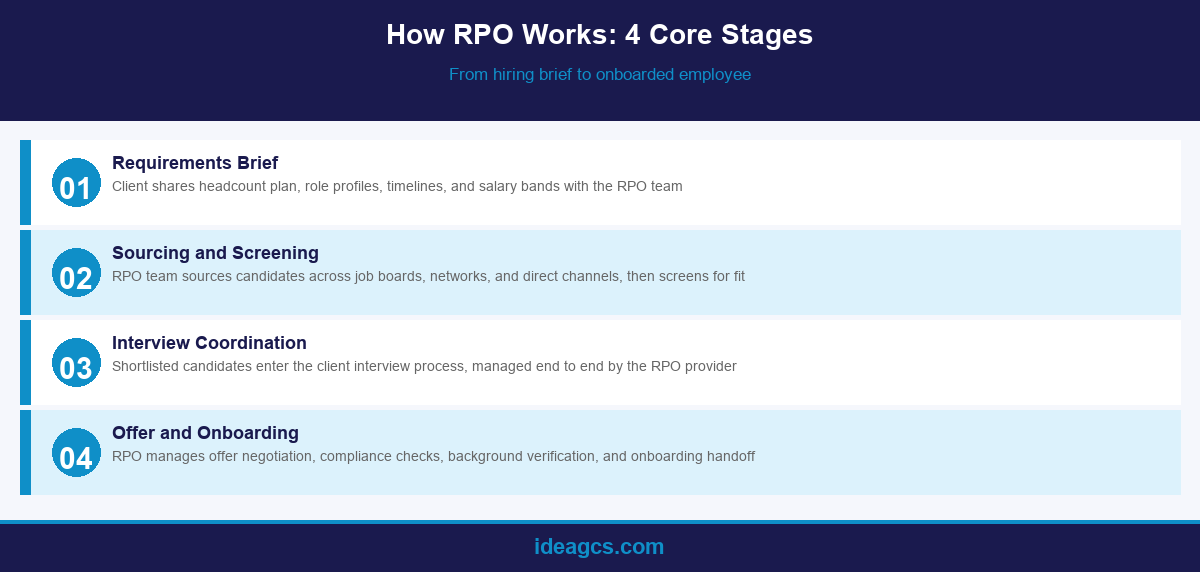
The RPO process begins with a detailed requirements brief covering headcount targets, role profiles, timelines, compensation bands, and any market-specific compliance requirements. The RPO team then builds a sourcing strategy across job boards, professional networks, social platforms, and talent databases appropriate to the role level and geography. Candidates are screened against the agreed criteria, and a shortlist is prepared for client review. Read our guide on why RPO is replacing traditional hiring models to understand the broader market shift that is driving enterprises toward this approach.
Interview scheduling, candidate briefing, feedback collection, and offer management are all coordinated by the RPO provider. Background checks and compliance verification are completed before the candidate's start date is confirmed. Post-placement support, including early tenure check-ins and attrition tracking, ensures the quality-of-hire metric reflects real retention outcomes rather than just initial placement counts. This end-to-end ownership is the core value proposition of RPO.
Who Benefits Most from RPO?
Organisations that benefit most from RPO typically share one or more of the following characteristics: they are growing faster than their internal HR team can support, they have high-volume hiring needs that strain in-house capacity, they are entering new markets where they lack local talent acquisition expertise, or they are experiencing persistently high cost-per-hire and time-to-fill metrics that suggest their current approach is not working effectively.
Technology companies scaling teams rapidly, professional services firms managing complex compliance requirements, and enterprises expanding into new geographies are all well-suited RPO clients. IdeaGCS specialises in these environments, bringing deep knowledge of the UK, India, US, UAE, and Philippines talent markets. To explore how RPO can address your specific hiring challenges, contact IdeaGCS today to arrange a discovery session with our talent acquisition team.
Recruitment process outsourcing gives organisations a structured, scalable, and accountable alternative to building and managing a large internal talent acquisition function. Whether you need full RPO coverage, selective support for specialist roles, or project capacity for a hiring surge, the right RPO model can reduce cost-per-hire, improve time-to-fill, and deliver consistently better candidate quality. IdeaGCS provides RPO services across the UK, India, US, UAE, and Philippines. Explore our full range of technical staffing and RPO services or contact our team to discuss your hiring requirements.
Frequently Asked Questions
What does RPO stand for in recruitment?

RPO stands for recruitment process outsourcing. It is a model in which an organisation transfers some or all of its talent acquisition activity to an external specialist provider who manages the hiring process on the client's behalf.
How does RPO differ from a staffing agency?
A staffing agency fills individual vacancies on request. An RPO provider takes process ownership across the full recruitment lifecycle, integrating into the client organisation and managing sourcing, screening, interview coordination, and onboarding as an embedded partner.
What are the main RPO models?
The main RPO models are full RPO, which covers all recruitment activity, selective RPO covering specific roles or geographies, and on-demand or project RPO for defined hiring surges. Each model has different commercial structures and suits different hiring volume profiles.
How much does RPO cost?
RPO pricing varies by model, scope, and volume. Common structures include cost-per-hire fees, monthly retained arrangements, and management-fee models. Most RPO engagements deliver cost savings of 20 to 40 percent compared to agency recruitment at equivalent volume.
How long does it take to set up an RPO engagement?
A standard RPO engagement typically takes four to eight weeks to implement, covering process design, technology setup, sourcing channel activation, and team onboarding. IdeaGCS can accelerate this timeline for clients with urgent hiring demand.
Is RPO suitable for small businesses?
Project RPO and selective RPO models are accessible for SMEs and startups with specific hiring needs. Full RPO is more cost-effective at higher volumes. IdeaGCS works with businesses of all sizes to find the right RPO model for their stage and budget.
What roles can RPO cover?
RPO can cover any role type, from volume entry-level positions to senior specialist and leadership appointments. IdeaGCS manages technical, commercial, operational, and executive recruitment through its RPO engagements across all five target markets.
How is RPO quality measured?
Key RPO quality metrics include time-to-fill, cost-per-hire, offer acceptance rate, hiring manager satisfaction, and 90-day retention rate. IdeaGCS reports against agreed SLAs for all metrics throughout the engagement, providing full transparency into recruitment performance.
Can RPO work alongside an existing HR team?
Yes. Most RPO engagements are designed to complement rather than replace internal HR. The RPO provider handles candidate-facing activity and process management while the internal team retains control of employer brand, compensation decisions, and final hiring approvals.
Where does IdeaGCS offer RPO services?
IdeaGCS delivers RPO services in the UK, India, US, UAE, and Philippines. Our recruitment team combines global reach with deep local market knowledge, enabling clients to scale hiring across multiple geographies through a single integrated RPO partnership.
Contact Us
Share on Social Media
Contact Us