RPO Recruitment Process: Step-by-Step Guide for Enterprises

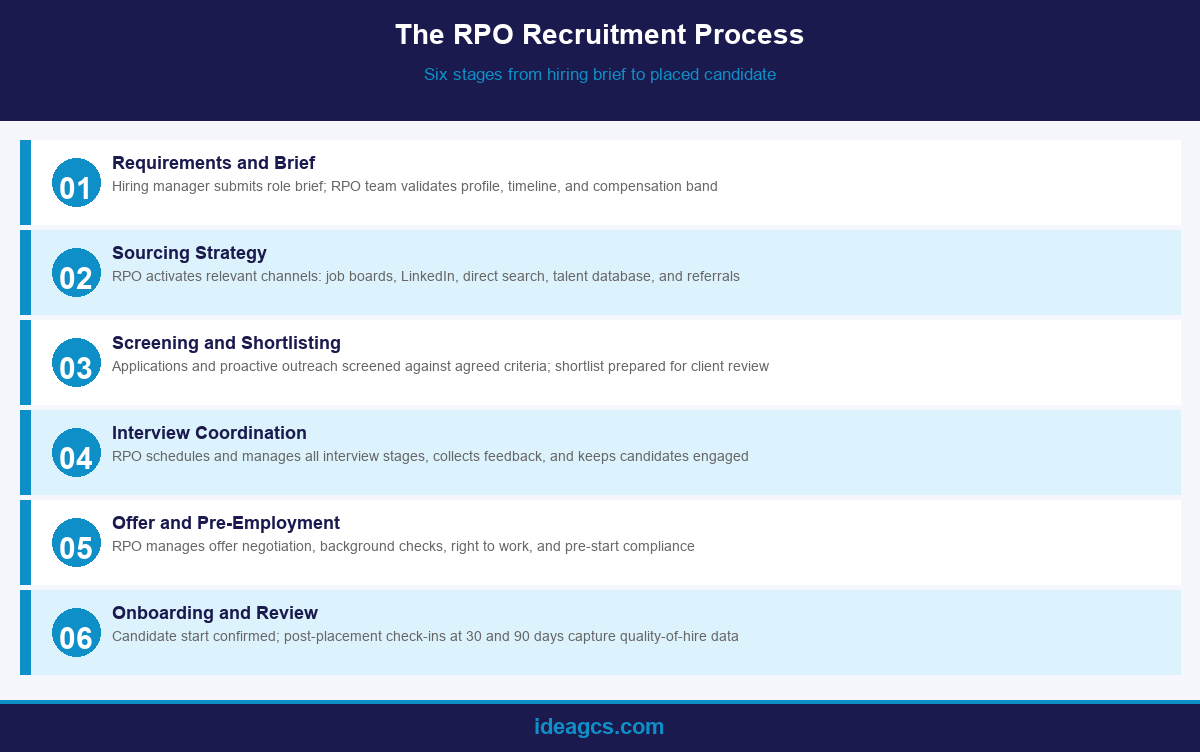
Understanding the RPO recruitment process step by step is essential for any organisation considering or currently running an outsourced talent acquisition model. While different RPO providers have their own methodologies, the core process follows a consistent structure from hiring brief through sourcing, screening, assessment, offer management, and onboarding. This guide walks through each stage in detail, explains what the RPO provider owns versus what the client retains, and identifies where process discipline has the greatest impact on hiring outcomes.
Key Takeaways
The RPO recruitment process covers six core stages: briefing, sourcing, screening, interview coordination, offer management, and onboarding
RPO providers own the process while clients retain approval authority at key decision gates including shortlist sign-off and final offer
IdeaGCS follows a structured six-stage RPO methodology with full SLA accountability at every stage
Stage 1 and 2: Requirements Brief and Sourcing Strategy
Every RPO recruitment cycle begins with a requirements brief submitted by the hiring manager. A well-structured RPO provider will have a standardised briefing template capturing role title, level, key responsibilities, essential and desirable skills, target compensation band, interview process design, and go-live timeline. The RPO account team validates the brief against market reality, flagging any misalignment between the compensation band and current market rates or any skills requirements that may create sourcing difficulty. This upfront alignment prevents wasted time and pipeline failure later in the process.
With a validated brief in hand, the RPO team builds a sourcing strategy tailored to the role level, geography, and candidate profile. Senior specialist roles require a different channel mix than volume entry-level positions. A data engineer in Bengaluru requires a different sourcing approach than a contact centre team leader in Manchester. The RPO provider's local market knowledge and candidate network depth determine how quickly and accurately this sourcing strategy delivers qualified candidates into the pipeline. For more context on how RPO strategy drives hiring outcomes, read the complete guide to RPO.
Stage 3 and 4: Screening, Shortlisting, and Interview Coordination
Screening is the stage where RPO providers add the most visible value in the early phases of an engagement. A competent RPO team screens not just for CV keywords but for genuine evidence of the capabilities specified in the brief. Phone screens and structured competency-based conversations replace the keyword-matching approach that produces high-volume shortlists of largely unsuitable candidates. The shortlist presented to the hiring manager should be a curated set of genuinely well-matched candidates, not a large list requiring extensive client-side filtering.
Interview coordination under RPO covers scheduling, candidate briefing, hiring manager preparation, and feedback collection after every interview stage. Candidate ghosting, which is common when coordination is left to internal teams managing multiple competing priorities, is virtually eliminated by a dedicated RPO coordinator whose sole focus is keeping the process moving. Feedback turnaround SLAs, typically 24 to 48 hours after each interview stage, prevent the candidate experience damage that results from long silent periods in a process.
Stage 5: Offer Management and Pre-Employment Checks
Offer management is a critical stage where RPO providers protect both the client and the candidate relationship. A skilled RPO team pre-qualifies candidate expectations on compensation, notice period, and any competing opportunities before the offer stage, reducing the risk of offer rejection or last-minute renegotiation. The offer is presented and negotiated by the RPO provider acting as the trusted intermediary, maintaining positive relationships with both the hiring manager and the candidate throughout. According to SHRM research on talent acquisition, offer acceptance rates in professionally managed recruitment processes are 15 to 20 percentage points higher than in unmanaged processes.
Pre-employment checks including background verification, reference checks, right to work confirmation, and any sector-specific compliance requirements are coordinated by the RPO provider. This removes a significant administrative burden from internal HR and ensures that compliance requirements are consistently met across all placements. The RPO provider maintains relationships with accredited background screening vendors, enabling faster turnaround on checks than most internal HR teams can achieve independently.
Stage 6: Onboarding and Quality-of-Hire Review
Onboarding support and post-placement quality review distinguish high-performance RPO engagements from those that treat placement as the end of the process. The RPO provider conducts check-ins with the placed candidate and hiring manager at 30 and 90 days post-start, capturing early retention signals and quality-of-hire feedback. This data feeds back into the sourcing and screening methodology, continuously improving the match quality of future shortlists. Contact IdeaGCS to understand how our six-stage RPO methodology drives consistent hiring outcomes for enterprise clients.
IdeaGCS follows this structured process for all RPO engagements across the UK, India, US, UAE, and Philippines. Every stage is governed by agreed SLAs with clear accountability metrics reported monthly to the client, providing full visibility into process performance and early warning of any deviation from target.
The RPO recruitment process, when executed with genuine discipline across all six stages, delivers consistently faster time-to-fill, lower cost-per-hire, and better quality candidates than unstructured in-house or multi-agency approaches. The key is process ownership: an RPO provider that genuinely manages each stage rather than acting as a passive intermediary between the client and candidate. IdeaGCS applies a structured six-stage RPO methodology to every engagement. Explore our technical staffing and RPO services to learn more about how we manage the full RPO recruitment process for enterprise clients.
Frequently Asked Questions
What are the steps in the RPO recruitment process?

The RPO recruitment process typically covers six stages: requirements briefing, sourcing strategy, screening and shortlisting, interview coordination, offer and pre-employment checks, and onboarding with quality review. Each stage is owned by the RPO provider and governed by agreed SLAs.
How long does the RPO recruitment process take?
A standard RPO recruitment process for a mid-level professional role typically takes four to eight weeks from brief to accepted offer. Senior specialist roles may take longer due to passive candidate engagement and longer notice periods. High-volume roles are typically faster with campaign-style processes.
What does an RPO provider own in the recruitment process?
An RPO provider owns process design, sourcing strategy, screening and shortlisting, candidate communication, interview scheduling, offer management, pre-employment checks, and onboarding coordination. The client retains approval authority at shortlist review, interview feedback, and final offer decisions.
What is the role of the hiring manager in an RPO process?
Hiring managers provide the role brief, review shortlists, conduct interviews, provide timely feedback, and make final hiring decisions. The RPO provider manages everything else, reducing the hiring manager's administrative burden while maintaining their authority over quality standards and candidate selection.
How does RPO handle candidate communication?
The RPO provider manages all candidate communication throughout the process, from initial outreach and application acknowledgement through screening feedback, interview invitations, and offer presentation. Communication operates under the client's employer brand and is governed by response time SLAs.
What happens if an RPO shortlist is not good enough?
A well-structured RPO engagement includes a feedback loop after every shortlist review. If shortlist quality is below standard, the RPO team recalibrates the sourcing and screening criteria based on hiring manager feedback and relaunches the pipeline. Most issues are resolved within one recalibration cycle.
How does RPO report on recruitment process performance?
RPO providers report on key metrics including applications received, screening pass rate, shortlist to interview conversion, interview to offer conversion, offer acceptance rate, and time-to-fill at each stage. IdeaGCS provides monthly performance reports with full pipeline visibility for all active roles.
Can the RPO process be customised for my organisation?
Yes. IdeaGCS designs RPO processes around each client's specific requirements, including assessment methodology, employer brand guidelines, compliance obligations, and technology environment. The six-stage framework is adapted to fit the client's hiring context rather than imposing a generic template.
Contact Us
Share on Social Media
Contact Us