OCR AI Agent for Legal Document Processing: A Complete Guide

OCR AI Agent for Legal Document Processing: A Complete Guide
Legal practices and in-house legal teams process some of the most complex, high-stakes documents in any profession. Contracts, court filings, due diligence materials, regulatory submissions, and litigation discovery sets demand accuracy, completeness, and confidentiality at every stage. OCR AI agent technology for legal document processing automates the extraction, classification, and routing of data from these document types at a scale and consistency that manual review cannot match, freeing legal professionals to focus on the analysis and judgement work that generates client value rather than the document handling that consumes time without adding it.
Key Takeaways
OCR AI agents extract contract metadata, identify clause variants, and populate matter management systems automatically from legal document review
Legal document processing demands accuracy and confidentiality standards that require a compliance-aware OCR AI agent architecture from the outset
IdeaGCS builds legal-grade OCR AI agents with end-to-end encryption, role-based access control, and complete audit trail logging
Contract Data Extraction and Matter Management
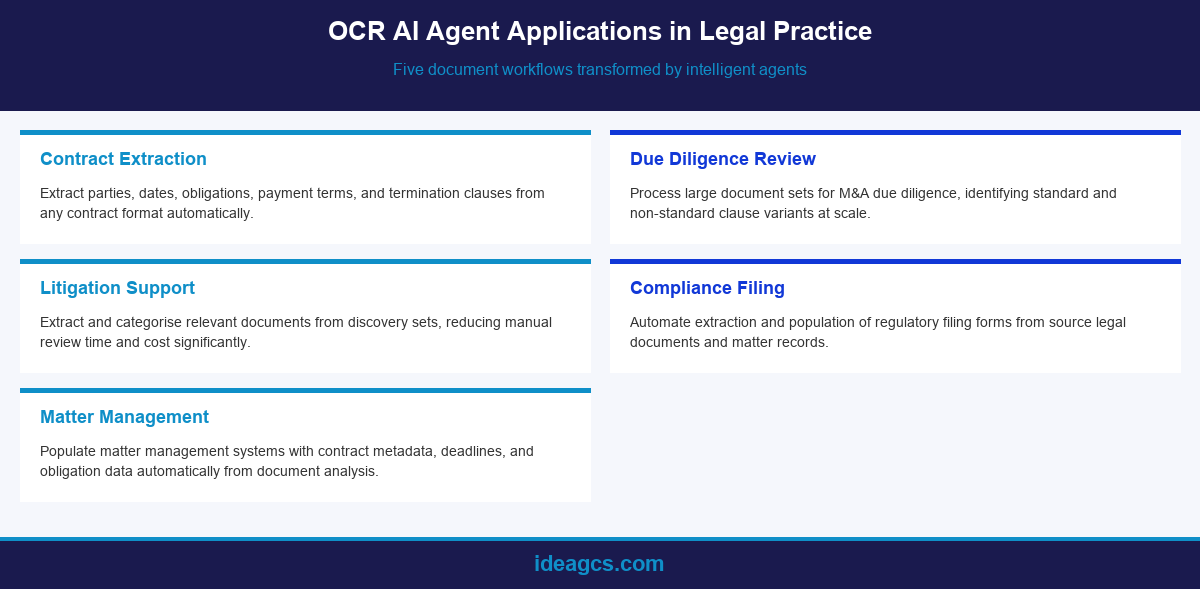
Contract data extraction is the foundational legal OCR AI agent use case. A typical law firm or in-house legal team manages hundreds or thousands of active contracts, each containing dozens of data points that matter management systems need: parties, effective dates, expiry dates, renewal terms, payment obligations, liability caps, governing law, dispute resolution mechanisms, and termination triggers. Manually entering this data from executed contracts is slow, error-prone, and creates a backlog that means contract registers are always out of date.
An OCR AI agent trained on contract documents extracts this metadata automatically from any contract format, regardless of whether the document is a standard template, a heavily negotiated custom agreement, or a scanned paper original. The extracted metadata is posted directly to the matter management system, keeping the contract register current without manual input. IdeaGCS trains legal OCR AI agents on client-specific contract populations, ensuring that the model recognises the clause types and data structures most relevant to the firm's practice areas. Explore our guide to AI OCR use cases across industries for the broader context of how document agents transform professional services workflows.
Due Diligence and Litigation Support
M&A due diligence requires reviewing hundreds or thousands of documents within compressed timescales to identify material obligations, risks, and non-standard provisions. An OCR AI agent accelerates this process by extracting key metadata from every document in the review set, classifying documents by type and relevance, flagging non-standard clauses against agreed criteria, and generating a structured data output that legal reviewers can analyse rather than read from scratch. The result is faster deal timelines and more consistent review quality across the document population.
Litigation discovery presents a related but distinct challenge: identifying responsive documents within very large collections under time pressure. OCR AI agents apply classification and keyword extraction across entire discovery sets, surfacing documents that match defined relevance criteria and organising them for attorney review. The reduction in manual review time is substantial. According to McKinsey's research on AI in professional services, AI-assisted legal document review reduces time-to-completion by 50 to 75 percent compared to purely manual review for equivalent document volumes.
Compliance Filing and Regulatory Document Automation
Legal departments in regulated industries manage ongoing obligations around regulatory filings, compliance reporting, and regulatory submission. OCR AI agents extract the source data needed for these filings from existing legal documents and matter records, automate population of standard form templates, and route completed submissions for lawyer review before filing. This reduces the time legal professionals spend on mechanical form completion while improving consistency and reducing the risk of omission errors that create regulatory exposure.
Confidentiality and data security are non-negotiable requirements for legal OCR AI agents. Every document processed may contain privileged communications, commercially sensitive information, or personal data subject to data protection law. IdeaGCS builds legal OCR AI agents with end-to-end encryption, role-based access control, complete audit trail logging, and configurable data retention policies that reflect the confidentiality obligations applicable to the document types processed. Contact IdeaGCS to discuss the security and compliance architecture for your legal OCR AI agent project.
Implementing an OCR AI Agent in a Legal Environment
Legal OCR AI agent implementation requires careful attention to four areas beyond the standard build process. First, training data governance: historical legal documents used for training must be appropriately anonymised or authorised for use, with clear data handling protocols agreed before collection begins. Second, clause taxonomy development: the agent's extraction accuracy for non-standard clause identification depends on a well-designed taxonomy of clause types developed with input from the practice groups who will use the system.
Third, matter management system integration: extracting contract metadata is only valuable when it flows directly into the DMS, PMS, or matter management platform the legal team uses. IdeaGCS builds integration layers for iManage, NetDocuments, Salesforce Legal, and proprietary matter management systems as part of every legal OCR AI agent engagement. Fourth, lawyer review workflow design: the agent must support rather than replace lawyer judgment for high-stakes decisions, with a review interface that presents extracted data clearly and makes human approval of agent outputs efficient. Explore our AI and data services to understand our legal OCR AI agent development process.
OCR AI agents are transforming legal document processing by automating the extraction, classification, and routing of data from contracts, due diligence sets, discovery collections, and compliance filings. The technology frees legal professionals from document handling to focus on the analytical and advisory work that delivers client value. Built with the right confidentiality architecture and matter management integrations, a legal OCR AI agent is one of the highest-impact technology investments a law firm or in-house legal team can make. IdeaGCS builds legal-grade OCR AI agents for law firms and in-house teams. Explore our AI and data services to discuss your legal document automation requirements.
Frequently Asked Questions
How can OCR AI agents help law firms?

OCR AI agents help law firms by extracting contract metadata automatically, accelerating due diligence document review, supporting litigation discovery processing, automating compliance filing population, and keeping matter management systems current without manual data entry.
What legal documents can an OCR AI agent process?
OCR AI agents process contracts, NDAs, court filings, due diligence documents, regulatory submissions, matter correspondence, and litigation discovery sets. The agent can be trained on any document type relevant to the firm's practice areas, extracting the specific metadata fields most valuable for each type.
Is OCR AI agent processing secure for confidential legal documents?
Yes, when built correctly. IdeaGCS builds legal OCR AI agents with end-to-end encryption, role-based access control, complete audit trail logging, and configurable data retention that reflects client confidentiality obligations. Security architecture is designed before development begins, not added after.
Can an OCR AI agent identify non-standard contract clauses?
Yes. OCR AI agents can be trained to identify non-standard clause variants by learning from annotated examples of standard and non-standard versions of each clause type. This capability is particularly valuable in M&A due diligence and contract portfolio review contexts.
How does OCR AI agent support due diligence?
For due diligence, an OCR AI agent extracts key metadata from all documents in the review set, classifies documents by type and relevance, flags non-standard clauses against agreed criteria, and generates structured output that legal reviewers can analyse rather than reading each document from scratch.
What matter management systems can a legal OCR AI agent integrate with?
IdeaGCS builds integrations with iManage, NetDocuments, Salesforce Legal, and proprietary matter management and DMS platforms. Extracted contract metadata and document classifications are posted directly to the relevant matter records without manual entry.
Does OCR AI agent replace lawyers in document review?
No. OCR AI agents handle the mechanical extraction and classification tasks that consume lawyer time without requiring legal judgment. Lawyers remain responsible for analysis, advice, and decisions. The agent supports lawyer judgment by surfacing relevant data more quickly and consistently than manual review.
How does IdeaGCS handle training data confidentiality for legal OCR?
IdeaGCS works with clients to establish appropriate training data governance before collection begins, including anonymisation requirements, data handling protocols, and authorisation for using historical documents in training. All training data is handled under strict confidentiality agreements. Visit the IdeaGCS blog for more on our data handling approach.
Contact Us
Share on Social Media
Contact Us