OCR AI Agent Development Cost 2026: Complete Pricing Guide

OCR AI agent development cost is one of the first questions organisations ask when evaluating intelligent document automation. It is also one of the most difficult to answer accurately without a detailed understanding of the scope, because an OCR AI agent that automates a single document type with one integration costs very differently from one that handles twenty document types across multiple business systems in a regulated industry. This guide breaks down the five cost drivers, provides indicative price ranges for different project scopes in 2026, and explains how to structure the investment to maximise return.
Key Takeaways
OCR AI agent development cost is driven by document complexity, workflow logic depth, integration scope, compliance requirements, and deployment model
Typical project ranges: GBP 50,000 to GBP 90,000 for simple deployments, GBP 90,000 to GBP 180,000 for mid-scope, GBP 180,000 and above for complex enterprise builds
IdeaGCS provides detailed estimates following a technical discovery session covering document types, workflow logic, integrations, and compliance requirements
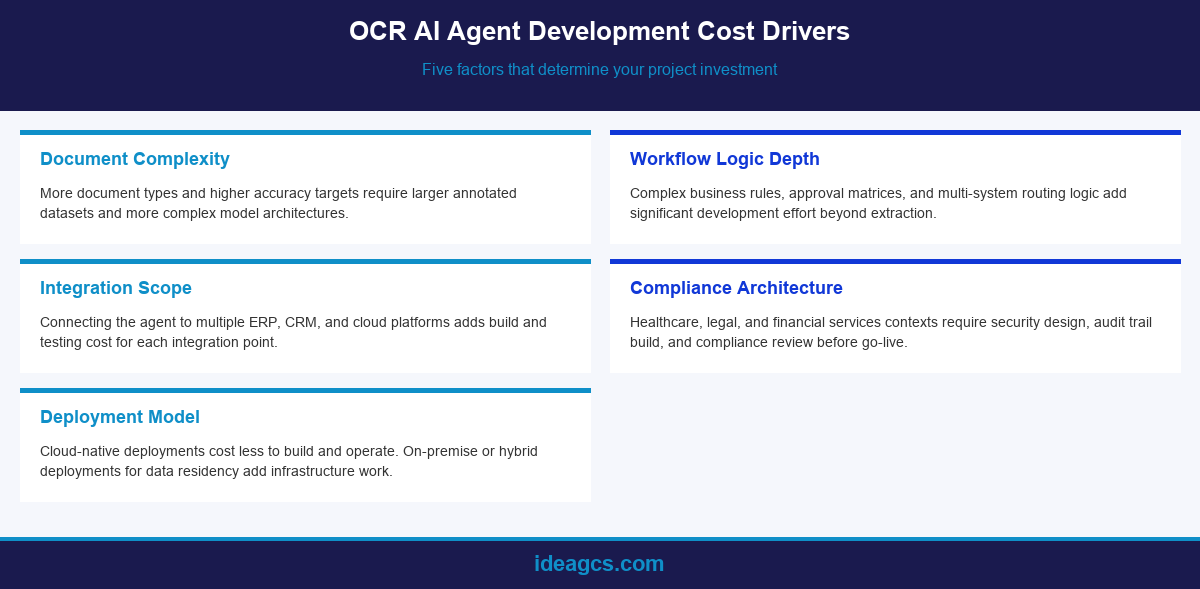
The Five Cost Drivers in OCR AI Agent Development
Document complexity is the primary cost driver. Processing a single, well-structured document type at moderate accuracy targets costs significantly less than processing twenty varied document types with high accuracy requirements, multi-language content, and handwriting. Each additional document type requires training data collection and annotation, model configuration, validation testing, and exception handling design. Accuracy targets also drive cost: a solution requiring 99 percent field-level accuracy on clinical documents demands more extensive training data and validation than one requiring 90 percent on internal administrative forms.
Workflow logic depth is the second major driver and the one that most distinguishes an OCR AI agent from a simple OCR extraction tool. Building the reasoning and action layers, including business rule engines, approval matrix logic, multi-system lookup capability, exception routing workflows, and audit trail infrastructure, is often as significant an investment as the extraction model itself. Organisations that underestimate this component during scoping typically encounter scope creep and budget overruns that trace back to the gap between extraction accuracy (what was scoped) and end-to-end workflow automation (what was needed).
Indicative OCR AI Agent Development Cost Ranges in 2026
Small-scope OCR AI agent projects covering one to three document types with a single ERP integration, straightforward workflow logic, and no compliance architecture requirements typically range from GBP 50,000 to GBP 90,000 in the UK market. This scope covers a standard accounts payable automation agent for a mid-size organisation with an established ERP and a relatively consistent invoice population.
Mid-scope projects covering five to ten document types, two to three system integrations, moderate workflow logic complexity, and basic compliance requirements range from GBP 90,000 to GBP 180,000. This covers most enterprise-scale AP, logistics, or healthcare onboarding automation projects. Complex enterprise builds covering fifteen or more document types, multiple ERP integrations, sophisticated approval and exception workflow logic, on-premise deployment, and full compliance architecture for regulated industries typically start at GBP 180,000. According to Gartner's IDP market analysis, organisations that invest adequately in workflow logic design during the build phase consistently achieve higher automation rates in production than those who focus budget on extraction capability alone.
Ongoing Operational Costs After Deployment
OCR AI agent development cost is a one-time investment; ongoing operational costs are structured separately. Post-deployment costs include model hosting on cloud or on-premise infrastructure, API infrastructure maintenance, performance monitoring, and model retraining as new document variants are encountered in production. IdeaGCS structures these as annual support and maintenance agreements, typically ranging from 15 to 25 percent of the original development investment per year depending on document volume, retraining frequency, and support level required.
Retraining frequency depends on how quickly the production document population evolves. A stable, narrow document population may require only annual retraining. A broad, rapidly evolving document set may require quarterly retraining cycles. IdeaGCS monitors extraction accuracy, exception rates, and confidence score distributions in real time for all deployed agents, providing early warning of accuracy degradation that indicates retraining is needed before it impacts operational performance. Contact IdeaGCS to discuss your OCR AI agent development requirements and receive a detailed cost estimate for your specific scope.
How to Maximise ROI on OCR AI Agent Development
Three principles consistently distinguish high-ROI OCR AI agent investments. First, design for end-to-end automation from the outset rather than adding workflow logic incrementally after the extraction model is built. Agents designed as extraction tools first and workflow agents second always require expensive retrofits to add the reasoning and action capability that delivers straight-through processing rates. The workflow logic design phase should be invested in as thoroughly as the extraction model development phase.
Second, invest in training data quality rather than cutting annotation costs to reduce upfront investment. Models trained on inadequate or homogeneous data underperform in production, requiring costly retraining cycles that exceed the saving from reduced annotation investment. Third, build the feedback loop from day one. An agent that captures human corrections from the exception queue and routes them to the retraining pipeline continuously improves its accuracy over the life of the deployment, compounding the ROI with each successive retraining cycle. IdeaGCS builds these three principles into every OCR AI agent engagement. Explore our AI and data services to understand our development approach.
OCR AI agent development cost in 2026 reflects the sophistication of what the technology is asked to do. Simple, narrow deployments are achievable at managed investment. Complex, enterprise-grade intelligent document agents require more significant commitment that pays back through automation rates, accuracy, and operational cost savings that compound over the life of the deployment. The key is scoping correctly from the start, investing in workflow logic and training data alongside extraction capability, and building the retraining feedback loop that makes the agent more valuable with each production cycle. IdeaGCS provides transparent development pricing based on detailed discovery of your specific requirements. Explore our AI and data services to arrange a scoping conversation.
Frequently Asked Questions
How much does OCR AI agent development cost?

OCR AI agent development typically costs GBP 50,000 to GBP 90,000 for simple deployments (1-3 document types, single integration), GBP 90,000 to GBP 180,000 for mid-scope projects, and GBP 180,000 and above for complex enterprise builds with multiple document types and integrations.
What factors affect OCR AI agent development cost?
The main cost drivers are document type count and complexity, training data annotation requirements, workflow logic depth, integration scope across ERP and cloud platforms, compliance architecture requirements, and whether cloud or on-premise deployment is needed.
Is OCR AI agent development more expensive than standard OCR?
Yes, because an OCR AI agent includes workflow reasoning and action layers beyond extraction. The higher upfront cost delivers significantly better automation rates and lower ongoing manual processing costs than standard OCR tools, typically resulting in lower total cost of ownership within 12 to 18 months.
What are the ongoing costs of an OCR AI agent after deployment?
Ongoing costs include model hosting, API infrastructure, performance monitoring, and retraining. IdeaGCS structures these as annual support agreements typically ranging from 15 to 25 percent of the original development investment, covering monitoring, reporting, and scheduled retraining cycles.
How long does OCR AI agent development take?
A standard OCR AI agent development engagement takes 10 to 16 weeks from discovery to production deployment. Complex enterprise builds with multiple document types, integrations, and compliance requirements may take 16 to 24 weeks. IdeaGCS provides detailed project plans at the start of each engagement.
Can I reduce OCR AI agent development cost with my own training data?
Yes. Providing quality historical documents for training data annotation reduces data collection cost and improves model accuracy. Organisations that can supply 500 or more diverse, representative documents for annotation reduce overall project cost compared to those starting from limited samples.
What is the ROI of OCR AI agent development?
ROI depends on current document processing volumes and costs. Organisations processing 1,000 or more documents per month manually typically recover OCR AI agent investment within 12 to 18 months through reduced data entry labour, lower error correction costs, and faster processing throughput. IdeaGCS models ROI projections during discovery.
Does IdeaGCS offer fixed-price OCR AI agent development?
Yes. IdeaGCS offers fixed-price engagements for projects with clearly defined scope including document types, accuracy targets, workflow logic requirements, and integrations. Variable-scope projects use a time-and-materials model with milestone billing. Contact IdeaGCS to learn more about our commercial models.
Contact Us
Share on Social Media
Contact Us