Legacy Policy Systems and MuleSoft: A Modernization Path for Insurance Carriers

Most insurance carriers still run policy administration, underwriting, and claims on core systems built ten, twenty, even thirty years ago. These platforms are stable, but they were never designed to talk to a mobile app, an agent portal, or a modern analytics tool. MuleSoft legacy modernization gives carriers a way to fix that gap without tearing out the core system that runs the business. Instead of a multi year rip and replace project, insurers connect what they already have to what they need next.
This guide is written specifically for insurance carriers, not generic enterprise IT. It covers where legacy policy systems actually break down, why full replacement is rarely the right first move, how an API led integration layer changes the equation, and what a realistic four phase modernization path looks like for a carrier's IT and operations leadership.
Key Takeaways
- Legacy policy, underwriting, and claims platforms usually fail at the integration layer, not the core processing logic.
- MuleSoft's API led connectivity lets carriers expose legacy data and transactions to new channels without touching the underlying system of record.
- A phased modernization path, assess, connect, modernize incrementally, then retire safely, reduces risk compared to a single large replacement project.
Why Legacy Policy Systems Hold Insurance Carriers Back
Core policy administration and claims systems were built for batch processing and internal staff use, not for real time quoting, self service portals, or partner data feeds. When a carrier wants to launch a new digital channel, developers often end up writing custom, one off connections directly into the legacy database or mainframe.
Each of those custom connections becomes another thing that can break during an upgrade, another integration a small team has to maintain, and another reason new projects take months longer than planned. Over time, the cost of working around the legacy system starts to outweigh the cost of running it.
This shows up in practical ways. A carrier launching a new agent self service portal might need three separate point to point integrations, one into policy admin for coverage data, one into claims for status updates, and one into billing for payment history. Each integration is built, tested, and maintained separately, and each one has to be rebuilt again the next time the legacy system is patched or upgraded. Multiply that across dozens of internal projects over several years and the integration debt becomes larger than the original legacy platform itself.
Why Rip and Replace Is Rarely the Right First Move
Replacing a core insurance platform is a multi year, high risk undertaking. Policy administration systems hold decades of in force business, complex state by state regulatory logic, and rating rules that took years to tune. A failed or delayed replacement project does not just cost money, it can disrupt renewals, claims payments, and regulatory reporting for real policyholders.
That risk is a large part of why carriers increasingly look at MuleSoft digital transformation as a lower risk starting point. Instead of betting the business on a single cutover, a carrier builds an integration layer that lets old and new systems run side by side, and replaces components only when there is a clear, tested reason to.
This mirrors what other regulated financial industries have learned the hard way. Banks facing similar core system constraints have largely moved away from single big bang replacements toward incremental, API first modernization, a pattern covered in more detail in IdeaGCS's look at digital transformation in banking and financial services. Insurance carriers are following a similar curve, a few years behind banking, but heading toward the same conclusion.
How MuleSoft Connects Legacy Insurance Systems Without Replacing Them
MuleSoft's Anypoint Platform uses an API led connectivity model with three layers: system APIs that expose data from the legacy policy, underwriting, or claims platform in a consistent way, process APIs that apply business logic like eligibility checks or claims routing, and experience APIs that shape data for a specific channel such as an agent portal or a mobile app.
For a carrier, this means the legacy system of record, whether that is a decades old policy admin platform or a more modern but still siloed underwriting tool, only needs to be connected once at the system API layer. Every new channel after that reuses the same secure, governed connection instead of another direct integration into core infrastructure. This is the same pattern IdeaGCS applies across product and application modernization work more broadly, adapted here to insurance specific systems like policy admin, underwriting, and claims.
In practice, a carrier's IT team builds one well tested system API for the claims platform, for example, and reuses it for the claims status feature in a mobile app, the claims dashboard an agent sees, and the data feed sent to a reinsurance partner. The legacy claims platform itself is touched once, during the initial connection, rather than once per project.
A Four Phase Modernization Path for Insurance Carriers
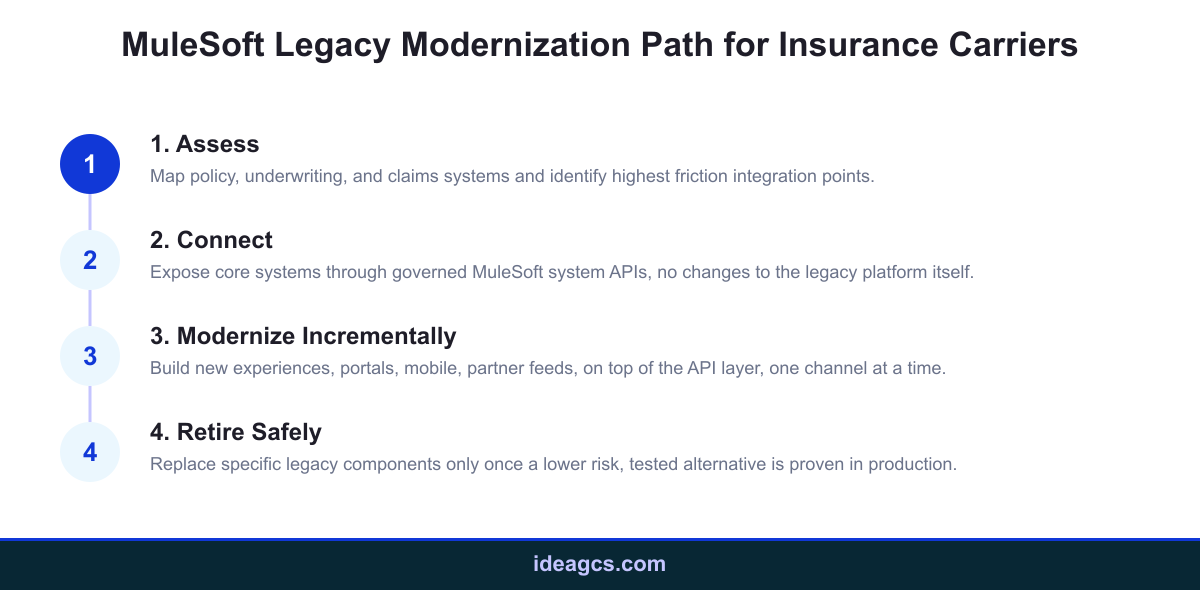
Carriers that succeed with legacy modernization tend to follow a similar sequence rather than attempting everything at once. The four phases below reflect how MuleSoft led modernization typically plays out inside an insurance IT organization, moving from assessment through to a safe, eventual retirement of true legacy components.
The assessment phase usually takes a few weeks and produces a prioritized map of which legacy systems, policy admin, underwriting, or claims, cause the most integration friction today. The connect phase builds the first governed system APIs against those priority systems. Incremental modernization then layers new digital experiences on top of that API foundation, one channel or workflow at a time, so business value shows up early instead of only at the end of a multi year project. Retirement of any specific legacy component only happens once a tested, lower risk replacement has proven itself in production.
What to Expect From MuleSoft Legacy Modernization in Insurance
Carriers that take this phased approach typically see faster delivery of new digital experiences, since teams build against a stable API layer instead of the legacy system directly. Compliance and audit reporting also tend to improve, because access to policy and claims data runs through a governed, logged API layer rather than ad hoc database connections.
None of this changes the fact that insurance remains a heavily regulated, data sensitive industry. Any modernization work needs to be planned alongside the compliance and consumer protection standards insurance regulators expect, which bodies like the National Association of Insurance Commissioners and the Insurance Information Institute document in detail. MuleSoft legacy modernization does not replace that governance work. It gives the carrier's technology team a cleaner, better controlled layer to build it on.
The organizations that get the most value from this approach usually treat it as an ongoing capability, not a one time project. New system APIs get added as new legacy touchpoints are identified, and the API catalog becomes a living map of the carrier's technology estate, useful well beyond the initial modernization effort.
Conclusion
Legacy policy, underwriting, and claims platforms are not going away overnight, and for most carriers they should not. The practical path is MuleSoft legacy modernization built around connection rather than replacement: expose the legacy system once through a governed API layer, build new digital experiences on top of it, and retire specific components only when there is a proven, lower risk reason to. Carriers that follow this path move faster on new channels while keeping the core systems that run their business stable.
If your team is scoping a legacy modernization project for policy, underwriting, or claims systems, talk to IdeaGCS about a phased, MuleSoft led approach built for insurance carriers.
Contact Us
Share on Social Media
Contact Us