How to Choose an AI OCR Development Company: 10 Key Criteria

How to Choose an AI OCR Development Company: 10 Key Criteria
Choosing the right AI OCR development company is one of the most important decisions in any document automation project. The quality of the AI model, the training data strategy, the integration capability, and the ongoing support model all determine whether your OCR solution performs at the accuracy levels your operation requires or becomes an expensive maintenance burden. This guide provides 10 specific criteria for evaluating AI OCR development companies and a practical approach to running the selection process.
Key Takeaways
The 10 criteria cover technical depth, training data strategy, accuracy benchmarking, integration capability, and commercial transparency
A proof of concept on your actual documents is the most reliable test of a provider's accuracy claims before you commit to a full engagement
IdeaGCS welcomes structured evaluations and provides PoCs, case studies, and client references for all procurement processes
The Technical Criteria: Model, Data, and Accuracy
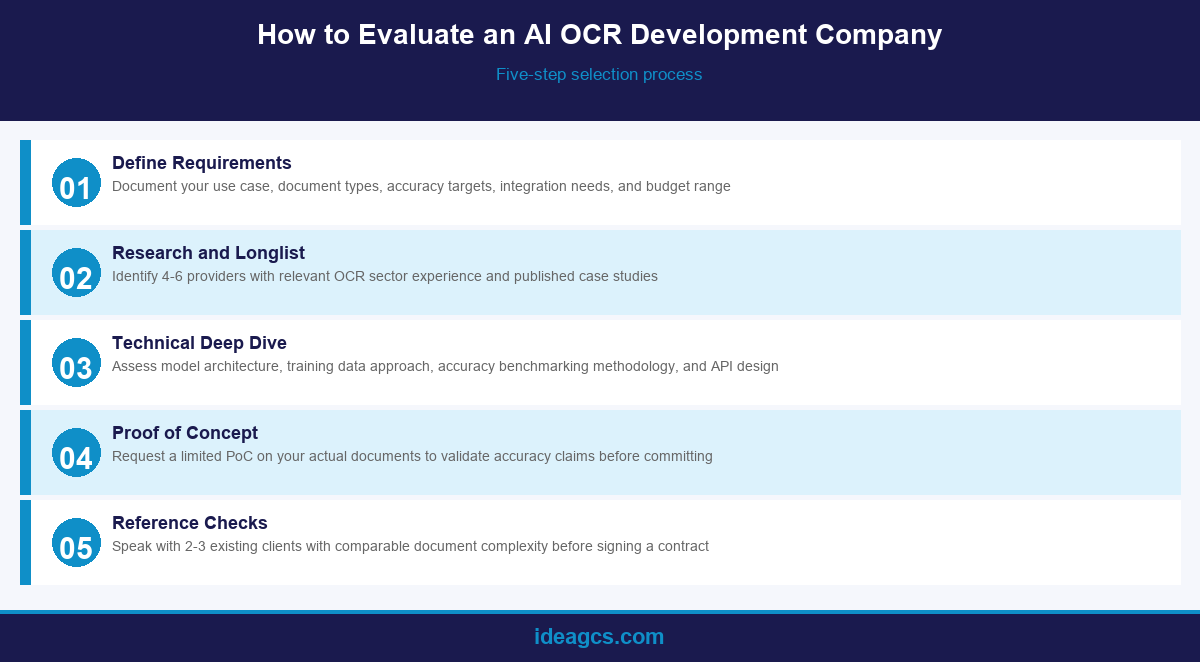
The first four criteria focus on technical capability. Does the provider use modern deep learning architectures (CNN, transformer, or hybrid) rather than legacy rule-based systems? What is their training data strategy: do they annotate training data specifically for your document types, or do they use generic pre-trained models that may underperform on your specific document population? How do they benchmark accuracy, and do they provide field-level accuracy metrics rather than document-level averages that can mask poor performance on individual fields?
The fourth technical criterion is API design. A production-grade AI OCR solution must expose its capabilities through a clean, well-documented REST API that can accept the document formats you process (PDF, TIFF, JPEG, PNG) and return structured JSON output with confidence scores for each extracted field. Providers without mature API design experience often deliver solutions that work in isolation but are difficult to integrate with ERP, CRM, or document management systems. Explore our AI OCR tools and automation guide to understand what production-ready AI OCR capability looks like in practice.
The Delivery Criteria: Process, Timeline, and Testing
Criteria five through seven cover delivery. Does the provider follow a structured development methodology with defined phases for requirements, data collection, model training, validation, integration, and deployment? What is their approach to user acceptance testing, and do they define accuracy acceptance criteria before development begins or only after the solution is built? What ongoing support and model retraining services do they offer post-deployment?
Timeline realism is equally important. Providers that promise production deployment within two to four weeks for a complex document automation project are either underestimating the work or proposing a generic solution that will not meet your accuracy requirements. A realistic timeline for a purpose-built AI OCR engagement is eight to sixteen weeks from requirements to production, depending on document complexity, training data availability, and integration scope. Request a detailed project plan from any provider before committing.
The Commercial Criteria: Transparency and Reference Checks
Criteria eight through ten cover commercial and reputational dimensions. Is the pricing structure transparent? Does the provider charge a fixed project fee, a per-page processing fee, a recurring licence, or a hybrid? Are ongoing costs for model retraining, hosting, and support clearly defined? According to Gartner's analysis of intelligent document processing providers, the most common source of client dissatisfaction in OCR engagements is unexpected costs for post-deployment support and model maintenance that were not clearly scoped in the initial contract.
Reference checks are the most reliable test of a provider's real-world delivery quality. Ask for references from clients with comparable document types, volumes, and integration requirements. Ask specifically about accuracy in production versus the accuracy demonstrated in the PoC, how the provider responded to performance issues after go-live, and whether they would engage the same provider again. IdeaGCS provides client references for every comparable engagement on request. Contact IdeaGCS to begin your evaluation and request our full capability presentation.
Running the Proof of Concept
A proof of concept on your actual documents is the most reliable differentiator between AI OCR providers. Provide a representative sample of your document population, including both structured and variable examples, and ask each shortlisted provider to extract a defined set of fields with accuracy metrics reported at the field level. Specify the acceptance criteria before the PoC begins: if field-level accuracy below 95 percent is not acceptable for your use case, make that the PoC pass threshold.
Evaluate PoC results critically. A provider that achieves 98 percent accuracy on the structured, clean documents in your sample while performing poorly on the degraded or variable examples is giving you a misleading picture of production performance. Your production document population will always be more diverse than a curated PoC sample. The provider that performs most consistently across the full range of your document types is the one most likely to deliver the accuracy you need at scale. IdeaGCS builds all engagements on a PoC-first approach. Explore our AI and data services for details on our development methodology.
Selecting the right AI OCR development company requires evaluating technical capability, training data strategy, accuracy benchmarking methodology, delivery process, commercial transparency, and real-world reference quality. The investment of time in a structured evaluation pays back many times over through an engagement that delivers the accuracy, reliability, and integration quality your operation requires. A PoC on your actual documents is the single most valuable step in any AI OCR provider evaluation. IdeaGCS welcomes structured evaluations and provides technical demonstrations, PoCs, and client references. Explore our AI and data development services to understand our approach.
Frequently Asked Questions
Contact Us
Share on Social Media
Contact Us