How Much Does Recruitment Process Outsourcing Cost? (2026 Guide)

Understanding RPO cost and pricing is essential for any organisation evaluating recruitment process outsourcing as a talent acquisition strategy. Unlike agency recruitment, which has a simple percentage-of-salary fee structure, RPO pricing is more nuanced and depends on the engagement model, hiring volume, role complexity, and geographic scope. This guide explains the main RPO pricing models, typical cost ranges for 2026, the factors that drive fees up or down, and how to assess whether RPO delivers a positive return on your talent acquisition investment.
Key Takeaways
RPO pricing follows four main models: cost-per-hire, management fee, cost-plus, and hybrid, each suited to different hiring profiles
RPO typically reduces cost-per-hire by 30 to 50 percent compared to agency recruitment at equivalent volume
IdeaGCS provides transparent RPO pricing with scoped estimates following a discovery session covering your hiring profile
The Four Main RPO Pricing Models
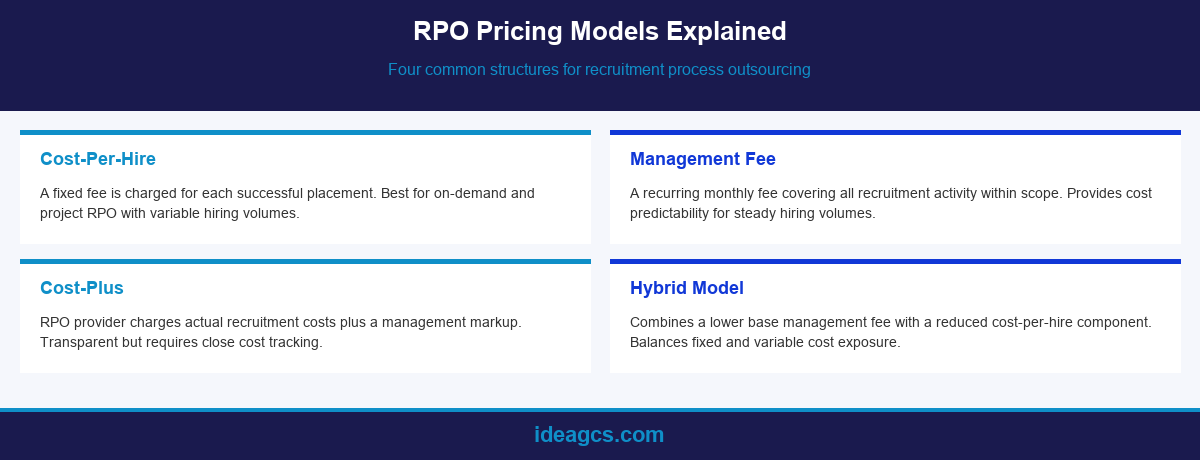
Cost-per-hire is the most straightforward RPO pricing model: the client pays a fixed fee for each successful placement made by the RPO provider. This model is common in on-demand and project RPO engagements where hiring volumes are variable and the client wants direct cost visibility tied to placement outcomes. Management fee structures charge a recurring monthly amount covering all agreed recruitment activity within the engagement scope, regardless of the number of hires made in a given month.
Cost-plus pricing involves the RPO provider charging the actual cost of recruitment activity, including sourcing tools, job board advertising, and assessments, plus a management markup covering their team and overhead costs. This model provides maximum transparency but requires detailed cost tracking. Hybrid models combine a lower base management fee with a reduced cost-per-hire component, balancing fixed cost predictability with variable cost alignment to actual hiring output. Most large RPO engagements use a hybrid structure.
Typical RPO Cost Ranges in 2026
Cost-per-hire rates for RPO engagements in 2026 typically range from GBP 1,500 to GBP 6,000 per placement in the UK, depending on role seniority, volume commitment, and the complexity of sourcing required. US market rates run broadly parallel, from USD 2,000 to USD 8,000 per hire. India and Philippines engagements tend to run at lower absolute cost due to compensation levels, though provider quality and process maturity vary significantly. According to Deloitte's global human capital research, organisations that move to RPO from multi-agency models report average cost-per-hire reductions of 30 to 50 percent within 12 months.
Management fee arrangements for full RPO covering 50 or more hires per year in the UK typically range from GBP 15,000 to GBP 40,000 per month, depending on role mix, volume, and service scope. These fees cover the dedicated RPO team, technology platform access, sourcing channel costs, and reporting infrastructure. At this scale, the cost-per-equivalent-hire under a management fee model is typically 40 to 60 percent lower than the cost of agency recruitment at the same volume.
What Drives RPO Cost Up or Down
Several factors push RPO costs higher. Role complexity and seniority increase the sourcing effort required, particularly for specialist technical or leadership positions where passive candidate engagement is necessary. Geographic scope adds cost when the RPO team needs local market expertise across multiple locations. Tight timelines create premium requirements, as accelerated sourcing typically requires broader channel investment and higher candidate engagement effort.
Factors that reduce RPO cost include higher hiring volumes, which allow the provider to amortise fixed infrastructure costs across more placements, longer contract terms, which reduce commercial risk for the provider and allow for lower per-hire pricing, and well-defined role profiles, which reduce sourcing and screening time. Providing the RPO provider with strong employer brand assets and responsive hiring managers also improves cost efficiency significantly. For a detailed pricing discussion, contact IdeaGCS and we will prepare a scoped estimate based on your specific hiring requirements.
Is RPO Cost-Effective Compared to Other Options?
The most accurate comparison for RPO cost is against the total cost of your current approach, not just agency fees. In-house recruitment teams carry significant fixed costs: salaries, benefits, technology licences, job board subscriptions, and management overhead. Agency recruitment at volume adds variable costs on top. When these are combined, the true cost-per-hire in a typical in-house and agency hybrid model is often two to three times higher than organisations realise. RPO replaces much of this cost with a single, transparent arrangement. Read our detailed complete guide to RPO for a full breakdown of how RPO structures compare to in-house recruitment total cost of ownership.
IdeaGCS RPO engagements are designed to deliver a clear return on investment from the first quarter. We provide cost-per-hire benchmarking at the start of every engagement so clients can measure saving accurately against their pre-RPO baseline. Our technical staffing and RPO services cover the UK, India, US, UAE, and Philippines, with commercial models tailored to the hiring volume and role mix of each client.
RPO cost in 2026 depends on the pricing model chosen, the volume and complexity of hiring, and the geographic markets involved. What is consistent across well-structured RPO engagements is the cost reduction relative to agency recruitment at volume, typically 30 to 50 percent lower cost-per-hire alongside significantly better process consistency and data quality. For organisations serious about making talent acquisition a strategic advantage rather than an operational overhead, RPO delivers measurable financial and quality returns. Contact IdeaGCS to discuss RPO pricing for your organisation and receive a scoped estimate based on your actual hiring requirements.
Frequently Asked Questions
How much does RPO cost per hire?

RPO cost-per-hire in the UK typically ranges from GBP 1,500 to GBP 6,000 per placement depending on role level, volume, and sourcing complexity. This is 30 to 60 percent lower than typical agency fees of 15 to 25 percent of first-year salary.
What are the different RPO pricing models?
The four main RPO pricing models are cost-per-hire, management fee, cost-plus, and hybrid. Cost-per-hire suits variable volume. Management fee suits steady hiring. Cost-plus maximises transparency. Hybrid balances fixed and variable cost exposure.
Is RPO cheaper than using a recruitment agency?
Yes, at volume. RPO reduces cost-per-hire by 30 to 50 percent compared to agency recruitment when hiring volumes are consistent. The saving is greatest for organisations making 20 or more hires per year through external recruitment channels.
What factors affect RPO pricing?
RPO pricing is affected by role seniority and complexity, hiring volume, contract length, geographic scope, timeline requirements, and the technology and sourcing channels included in the engagement scope. Higher volumes and longer contracts generally produce lower per-hire pricing.
Is there a minimum commitment for RPO?
Most full RPO arrangements require a minimum contract term of 12 months to allow for proper process implementation and ramp-up. Project and on-demand RPO can operate over shorter periods. IdeaGCS structures engagements to match the client's hiring horizon and volume.
How do I calculate RPO return on investment?
RPO ROI is calculated by comparing the total cost of the RPO engagement against the sum of agency fees, internal recruiting team costs, and technology costs that it replaces. Most organisations see a positive ROI within 6 to 12 months of RPO go-live.
What does an RPO management fee include?
A management fee typically covers the dedicated RPO team, access to the recruitment technology platform, job board and sourcing channel costs, candidate screening and assessment, interview coordination, and reporting infrastructure. Costs outside agreed scope may be billed separately.
Can RPO pricing be adjusted as hiring volumes change?
Yes. Most RPO contracts include volume adjustment mechanisms, allowing fees to scale up or down as headcount plans change. IdeaGCS builds flexibility into all engagement structures to accommodate business growth, slowdowns, and seasonal hiring variations.
Contact Us
Share on Social Media
Contact Us