Benefits of RPO for Tech Startups Scaling Rapidly

For tech startups entering a growth phase, the ability to hire fast, hire well, and hire cost-effectively is often the difference between capturing market opportunity and falling behind. Yet most early-stage companies lack the internal HR infrastructure to support rapid scaling. RPO for tech startups offers a compelling solution: specialist recruitment capability that can be activated quickly, scales with headcount demand, and delivers the quality and speed of hire that investor timelines and product roadmaps demand. This guide explains exactly how RPO supports tech startup growth.
Key Takeaways
Tech startups using RPO can scale from 5 to 50 hires per month without building and managing an internal TA team
RPO providers with tech sector expertise understand engineering roles, compensation benchmarks, and passive candidate engagement
IdeaGCS RPO supports fast-growing tech companies across the UK, India, US, UAE, and Philippines
Why Tech Startups Struggle with Traditional Hiring
Traditional hiring approaches create serious friction for fast-growing tech startups. Building an internal talent acquisition team takes time, money, and management bandwidth that most startups cannot spare. Recruiting through agencies is faster but expensive: at 20 percent of salary for technical roles, hiring 30 engineers over 12 months can cost GBP 300,000 or more in placement fees alone. Using a mix of job boards, referrals, and ad hoc agency relationships produces inconsistency in candidate quality, employer brand presentation, and hiring speed.
The deeper problem is capacity. As a startup scales, hiring demand accelerates faster than the ability to build sustainable internal recruitment capability. A single internal recruiter who manages well at 10 hires per quarter cannot manage 40. Bringing in agencies to fill the gap creates the cost and fragmentation problems described above. Tech startups need a solution that scales with them rather than one that requires constant re-engineering as headcount targets increase.
How RPO Solves the Startup Talent Acquisition Problem
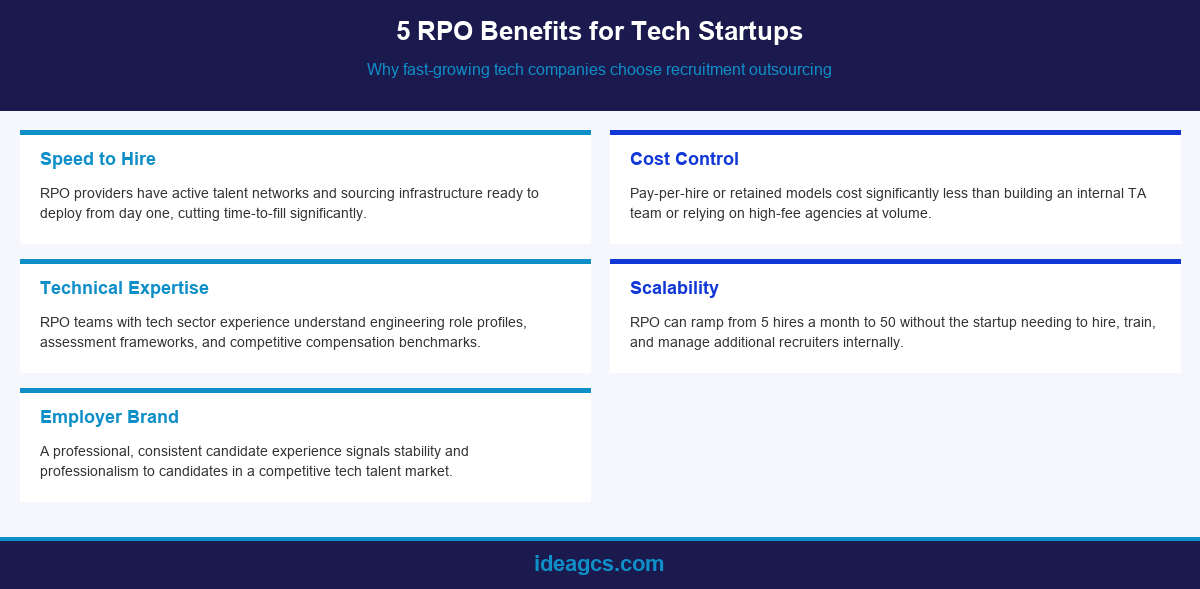
RPO gives a tech startup immediate access to a fully resourced recruitment team without the hiring, onboarding, and management overhead of building that team internally. The RPO provider brings existing sourcing infrastructure, technology platforms, candidate networks, and sector expertise that would take 12 to 18 months to build from scratch. For a startup that needs to hire 20 engineers in the next quarter, this means a deployable recruitment capability rather than a standing start. Read more about why RPO is replacing traditional hiring models across industries including technology.
The process accountability built into RPO engagements is particularly valuable for startups. Hiring managers in fast-growing tech companies typically lack experience managing high-volume recruitment. RPO providers structure the process, drive hiring manager behaviour, and ensure candidate pipelines stay active even when internal teams are fully absorbed in product and commercial priorities. This structured accountability is what allows a startup to maintain hiring velocity through periods of intense operational pressure. Explore IdeaGCS technical staffing and RPO services designed for high-growth technology companies.
Speed and Cost Benefits for Fast-Growing Tech Teams
Time-to-fill is the most critical metric for a startup in growth mode. Every unfilled engineering role represents delayed product development, missed sprint commitments, and compounding workload on existing team members. RPO providers with active tech talent networks can typically reduce time-to-fill for mid-level engineering roles from eight to twelve weeks under a standard agency model to four to six weeks under an active RPO engagement. This acceleration has a direct impact on product velocity and team morale.
On cost, RPO typically delivers a 30 to 50 percent reduction in cost-per-hire compared to agency recruitment at equivalent volume. For a startup hiring 40 technical roles per year at an average salary of GBP 60,000, moving from agency (20 percent fee) to RPO can save GBP 200,000 to GBP 250,000 annually. These savings compound as headcount grows, making RPO increasingly cost-effective relative to agency recruitment as the company scales.
What to Look for in an RPO Partner for Tech Startups
Not all RPO providers are equipped to serve tech startups. The right partner should have demonstrable experience hiring for technical roles, including software engineers, data scientists, DevOps specialists, and product managers, not just generalist or commercial positions. They should understand the competitive dynamics of the tech talent market, have active networks of passive candidates, and be able to articulate the startup's employer value proposition compellingly to candidates who have multiple options.
Flexibility is equally important. A startup RPO partner should be able to ramp up hiring capacity quickly when headcount plans accelerate and scale back without significant commercial penalty when plans change. Transparent SLA reporting, regular pipeline reviews with hiring managers, and a clear escalation process for hard-to-fill roles are all signs of an RPO provider built for the pace of a tech startup. Contact IdeaGCS to discuss how our RPO model supports tech company growth across our five target markets.
RPO offers tech startups a genuine alternative to the false choice between building expensive internal TA teams and paying high agency fees. The right RPO partner delivers speed, cost efficiency, quality of hire, and the scalability to match any growth trajectory. As headcount targets increase, RPO becomes progressively more cost-effective and strategically valuable. IdeaGCS brings tech sector recruitment expertise and five-market reach to every RPO engagement. Explore our recruitment and staffing services or contact our team to discuss your startup hiring requirements.
Frequently Asked Questions
Can a startup use RPO?

Yes. Project and selective RPO models are well-suited for startups with specific hiring surges or ongoing technical role needs. IdeaGCS designs RPO engagements for companies at all stages, from early-growth startups to established scale-ups, across UK, India, US, UAE, and Philippines.
How does RPO help startups scale hiring?
RPO provides a fully resourced recruitment team and sourcing infrastructure from day one. Startups gain immediate capacity to scale from single-digit to double-digit monthly hires without building and managing an internal talent acquisition function.
Is RPO cost-effective for startups?
Yes. RPO reduces cost-per-hire by 30 to 50 percent compared to agency recruitment. For a startup hiring 30 or more technical roles per year, the saving compared to typical agency fees is significant and compounds as headcount growth continues.
How quickly can RPO be set up for a startup?
IdeaGCS can implement an RPO engagement for a tech startup in four to six weeks, covering process design, sourcing channel activation, employer brand alignment, and hiring manager onboarding. Accelerated timelines are available for clients with urgent demand.
What tech roles can RPO cover?
RPO can cover any technical role including software engineers, data scientists, DevOps engineers, product managers, QA specialists, and technical architects. IdeaGCS has specific experience across these disciplines in the UK, India, US, UAE, and Philippines markets.
Does RPO work for remote-first tech companies?
Yes. IdeaGCS RPO is designed to support remote and distributed hiring across multiple markets. Our sourcing and assessment processes are optimised for remote-first environments, including virtual interview coordination and distributed onboarding support.
How does RPO protect employer brand for startups?
The RPO provider operates entirely under the client's employer brand, presenting the opportunity using the startup's own messaging, culture narrative, and value proposition. This consistency improves candidate experience and offer acceptance rates compared to agency-mediated hiring.
What metrics should a startup track in an RPO engagement?
Key metrics include time-to-fill per role type, cost-per-hire, offer acceptance rate, hiring manager satisfaction score, and 90-day retention rate. IdeaGCS provides a real-time reporting dashboard for all RPO clients covering these metrics throughout the engagement.
Contact Us
Share on Social Media
Contact Us