AI OCR vs Traditional OCR: Which Should Your Business Choose?

AI OCR vs Traditional OCR: Which Should Your Business Choose?
The AI OCR vs traditional OCR comparison is one that every organisation evaluating document automation must work through carefully. Both technologies extract text from documents, but they differ fundamentally in how they handle variability, accuracy, learning capability, and integration with business systems. The right choice depends on your document types, volume, accuracy requirements, and integration environment. This guide breaks down the key differences and helps you determine which approach will deliver the best outcome for your specific business context.
Key Takeaways
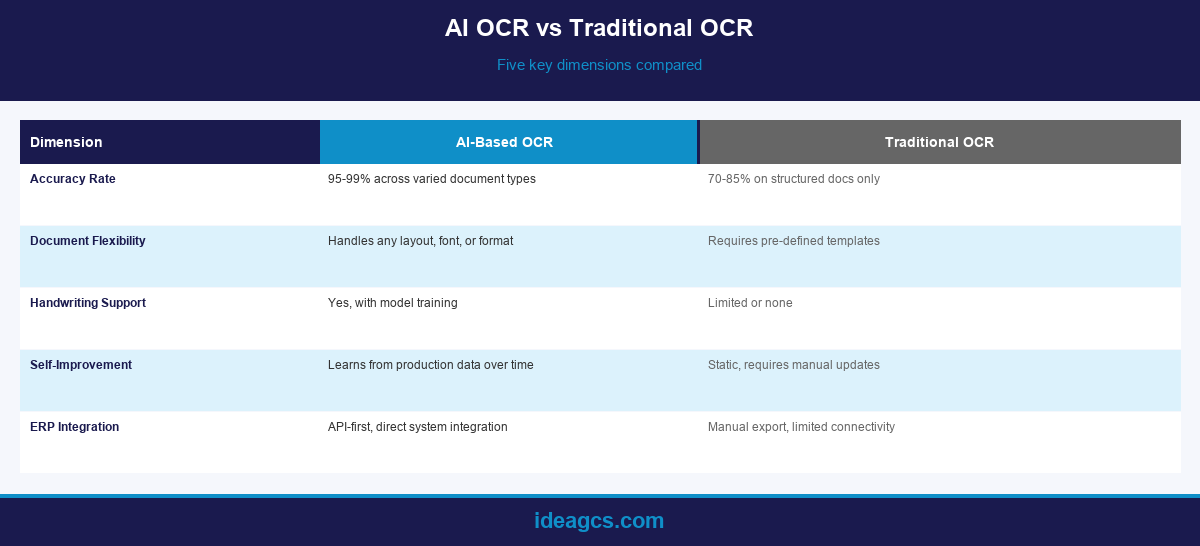
AI OCR achieves 95 to 99 percent accuracy across varied document types versus 70 to 85 percent for traditional OCR on structured documents only
Traditional OCR requires pre-defined templates and fails when documents deviate from expected layouts or fonts
IdeaGCS builds custom AI OCR solutions for enterprises that need reliable performance across real-world document populations
How Traditional OCR Works and Where It Falls Short
Traditional OCR systems use rule-based pattern matching to identify characters in document images. They are trained on specific fonts and layouts, and they perform acceptably when documents conform precisely to expected templates. A well-designed traditional OCR system can achieve high accuracy on structured printed forms where the layout, font, and field positions are consistent across every document processed. The technology has been in use for decades and powers many legacy document management and data capture systems.
The limitations of traditional OCR become apparent the moment document variability enters the equation. A supplier invoice from a new vendor with a different layout, a handwritten field in a printed form, a scanned document with slight rotation or degraded print quality, or a multi-column document layout can all cause traditional OCR accuracy to drop sharply. For enterprises processing documents from multiple sources or with any variability in format, this brittleness creates persistent exceptions that require manual correction. Read our article on why manual document processing slows businesses down to understand the cost of these exceptions at scale.
How AI OCR Handles What Traditional OCR Cannot
AI-based OCR replaces rule-based pattern matching with deep learning models trained on large datasets of real-world documents. Rather than requiring a predefined template for each document type, an AI OCR model learns to recognise text and structure across a wide range of layouts, fonts, image qualities, and languages. The model builds an understanding of contextual relationships between text elements, enabling it to correctly interpret ambiguous characters, handle degraded scan quality, and process documents it has not explicitly seen during training.
The practical result is accuracy of 95 to 99 percent across diverse document populations, compared to the 70 to 85 percent typical of traditional OCR on structured documents only. For a finance team processing invoices from hundreds of different suppliers, this accuracy difference translates directly into fewer exceptions, less manual review time, and lower processing cost per document. Explore our guide to AI OCR use cases across industries to see how this accuracy advantage applies in specific operational contexts.
Comparing Cost and Return on Investment
Traditional OCR systems have lower upfront implementation costs for narrow, well-defined document types. When a business processes only one or two document formats with consistent layouts, a traditional OCR solution can be adequate and cost-effective. The cost disadvantage emerges in the ongoing maintenance required to update templates when supplier formats change, the manual exception handling cost, and the labour required to correct errors at scale.
AI OCR has a higher initial development cost because model training requires annotated document datasets and specialist machine learning expertise. However, the total cost of ownership over a three to five year horizon is consistently lower than traditional OCR for any organisation processing varied document types at volume. The reduction in exception handling labour, the elimination of template maintenance, and the self-improving accuracy of AI models over time all contribute to a lower cost base. For a detailed breakdown, see our guide to the cost of building a custom AI OCR solution. Contact IdeaGCS to discuss the right approach for your document processing requirements.
Which Should Your Business Choose?
Traditional OCR remains a viable option for organisations processing a small number of highly consistent document formats with predictable layouts, fonts, and quality levels. If your document population genuinely never varies from a known template, traditional OCR can deliver acceptable accuracy at lower upfront cost. The caveat is that most real-world document processing environments are not this predictable, and the cost of exceptions increases as document variety grows.
AI OCR is the right choice for any organisation processing documents with variability in layout, format, font, language, or image quality. It is also the only viable option for handwriting recognition, mixed document type processing, and applications where accuracy above 90 percent is a non-negotiable operational requirement. IdeaGCS specialises in building custom AI OCR solutions calibrated to each client's specific document population. Explore our AI and data services to understand our development approach.
The AI OCR versus traditional OCR decision comes down to document variability and accuracy requirements. Traditional OCR serves narrow, controlled document environments adequately. AI OCR is the only approach that reliably handles the variability and accuracy demands of real-world enterprise document processing at scale. The initial investment in AI OCR development pays back through lower exception rates, reduced manual processing labour, and continuous self-improvement that makes the system more valuable over time. IdeaGCS builds custom AI OCR solutions for enterprises across the UK, India, US, UAE, and Philippines. Explore our AI and data services to discuss your document automation requirements.
Contact Us
Share on Social Media
Contact Us