AI OCR Integration with SAP, Salesforce, and Cloud Platforms

The value of an AI OCR solution is fully realised only when extracted data flows directly into the business systems that depend on it. An OCR tool that produces accurate data extractions but requires manual transfer to an ERP, CRM, or cloud platform adds process steps rather than eliminating them. AI OCR ERP integration is what transforms a document scanning tool into a genuine workflow automation capability. This guide covers how AI OCR integrates with SAP, Salesforce, Microsoft Dynamics, and cloud platforms, the technical architecture involved, and the common integration challenges and how to solve them.
Key Takeaways
AI OCR integration uses REST APIs to deliver extracted document data directly into ERP, CRM, and cloud platforms without manual transfer
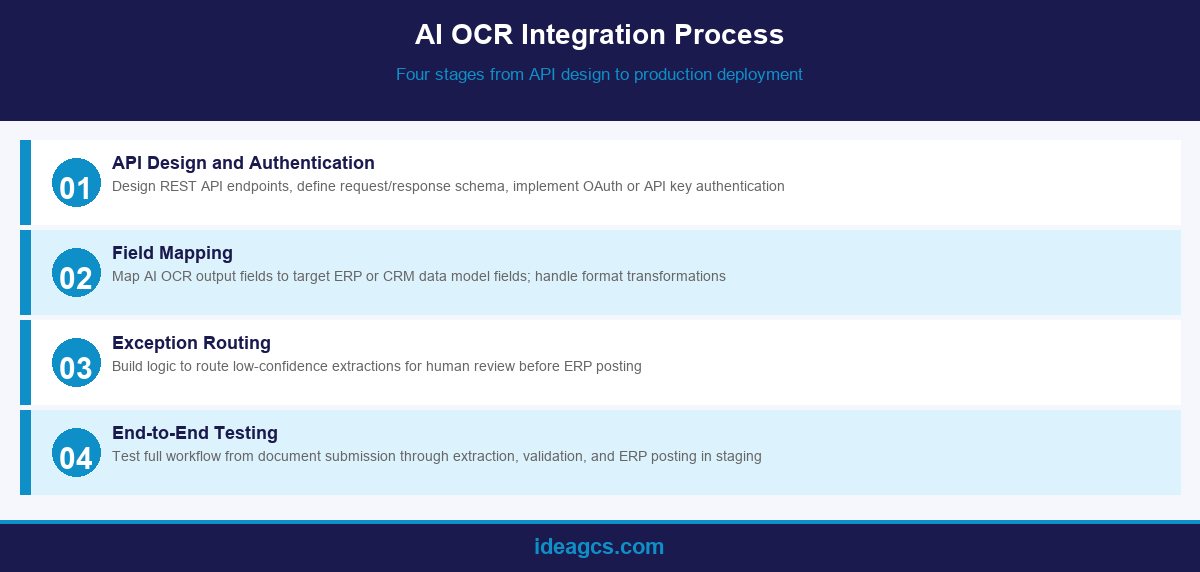
Field mapping, exception routing, and end-to-end testing are the three critical components of any AI OCR integration project
IdeaGCS builds and deploys AI OCR integrations with SAP, Oracle, Microsoft Dynamics, Salesforce, and leading cloud platforms
Why Integration Is Essential in AI OCR Deployments
Document automation that stops at data extraction creates a new bottleneck rather than eliminating an old one. If an AI OCR system extracts invoice data accurately but the extracted values must be manually copied into the ERP system, the automation has only shifted the manual work from reading and typing to copy-and-paste. True automation requires the OCR system to deliver structured data directly to the target system's data model through an API integration that handles the complete workflow from document submission to confirmed ERP posting.
The integration layer also provides the audit trail and exception management infrastructure that enterprise environments require. Every document processed must generate a record of what was extracted, what was validated, what was posted to the ERP, and what required human review. Without this infrastructure, the automation creates opacity rather than transparency in the document processing workflow. Explore our article on intelligent document processing to understand how integration fits within the broader IDP architecture.
Integrating AI OCR with SAP and Oracle
SAP integration is one of the most common requirements in AI OCR deployments for enterprise finance teams. IdeaGCS AI OCR solutions connect to SAP using SAP's BAPI or RFC interfaces for direct function calls, SAP's REST API (SAP Business Technology Platform), or SAP's iDocs framework for batch processing. The integration maps extracted invoice fields to the corresponding SAP MM and FI module fields, handles purchase order lookup and three-way matching logic, and manages the posting workflow for approved invoices including accounting document creation.
Oracle integration follows similar patterns using Oracle's REST APIs, Oracle Integration Cloud, or direct database integration depending on the Oracle product version and client infrastructure. Microsoft Dynamics 365 integration uses the Dynamics Web API. In each case, the AI OCR system acts as a data producer delivering structured JSON to an API endpoint exposed by the ERP, with the ERP handling the business logic for validation and posting. IdeaGCS manages the full integration design, build, and testing process. Contact IdeaGCS to discuss ERP integration requirements for your AI OCR project.
AI OCR Integration with Salesforce and Cloud CRMs
CRM integration is most common in sales, customer service, and contract management contexts where AI OCR extracts data from customer-submitted documents (signed contracts, order forms, proof of identity, or onboarding documentation) and populates the corresponding Salesforce or CRM records automatically. Salesforce integration uses the Salesforce REST API or SOAP API, with extracted document data mapped to Opportunity, Account, Contract, or custom object fields depending on the use case.
Cloud platform integration (AWS, Azure, GCP) is relevant for organisations using cloud-native document management workflows. AWS S3-triggered processing, Azure Blob Storage events, and Google Cloud Storage notifications can be used to trigger AI OCR processing automatically when documents are uploaded to defined storage locations. Extracted data is then posted to downstream services, databases, or APIs using the cloud provider's native integration tools. IdeaGCS supports all three major cloud platforms for AI OCR deployment and integration.
Integration Challenges and How to Solve Them
The most common integration challenge is field mapping complexity. ERP systems have data models that do not always align cleanly with the fields extractable from source documents. Tax codes, cost centres, GL account assignments, and approval workflows all require configuration in the ERP that must be designed before the AI OCR integration can be built. A second challenge is exception management: the integration must correctly handle documents where AI OCR confidence scores fall below the acceptance threshold, routing them to a human review queue rather than attempting automatic ERP posting with low-confidence data. According to Gartner's IDP guidance, exception management design is the component most frequently underestimated in AI OCR integration projects.
Authentication and security are equally important. API credentials must be managed securely, data in transit must be encrypted, and access controls must prevent unauthorised access to the extracted document data. IdeaGCS addresses all of these challenges as standard components of every integration engagement. Explore our AI and data services to understand our integration delivery approach.
AI OCR integration with SAP, Salesforce, and cloud platforms is the step that transforms document scanning into genuine enterprise workflow automation. The technical complexity is real but manageable with the right expertise, and the operational benefit, eliminating manual data transfer between OCR output and business systems, justifies the integration investment many times over. Planning for exception management and audit trail completeness from the start avoids the costly retrofits that organisations encounter when they treat integration as an afterthought. IdeaGCS builds and deploys AI OCR integrations for enterprise clients. Explore our AI and data services to discuss your integration requirements.
Frequently Asked Questions
How does AI OCR integrate with SAP?

AI OCR integrates with SAP using BAPI/RFC function calls, SAP BTP REST APIs, or iDocs for batch processing. Extracted document fields are mapped to SAP MM and FI module data structures, with three-way matching logic and automated posting for validated invoices managed by the integration layer.
Can AI OCR connect to Salesforce?
Yes. AI OCR integrates with Salesforce using the Salesforce REST or SOAP API, mapping extracted document data to Opportunity, Account, Contract, or custom object fields. Common use cases include contract data extraction, customer onboarding document processing, and sales order form automation.
What cloud platforms support AI OCR integration?
AI OCR can be deployed on and integrated with AWS, Azure, and GCP. Cloud storage events (S3 triggers, Azure Blob notifications, GCS events) can automatically trigger OCR processing when documents are uploaded. IdeaGCS supports all three platforms for both AI OCR hosting and integration.
What is field mapping in AI OCR ERP integration?
Field mapping translates AI OCR output field names and data formats into the corresponding ERP data model fields. For example, mapping the extracted 'Total Amount' field to the SAP FI document currency amount field, with format conversion from string to the ERP's numeric format.
How does exception management work in AI OCR ERP integration?
Exception management routes documents where AI OCR confidence scores fall below the defined threshold to a human review queue rather than attempting automatic ERP posting. Reviewers verify or correct extracted values and approve posting. IdeaGCS builds the review interface as part of all integration engagements.
Does AI OCR integration require custom development?
Yes. Every AI OCR ERP integration requires custom development to handle field mapping, exception routing, authentication, and the specific ERP version and module configuration of the client's environment. IdeaGCS provides the full integration development and testing as part of every AI OCR engagement.
How long does AI OCR ERP integration take?
AI OCR ERP integration typically adds four to six weeks to the overall project timeline for a standard SAP or Dynamics integration. Complex multi-system integrations or cloud platform deployments may take longer. IdeaGCS provides detailed project plans for each integration scope.
What security standards apply to AI OCR ERP integration?
AI OCR ERP integrations must implement API authentication (OAuth 2.0 or API keys), TLS encryption for data in transit, role-based access control, and comprehensive audit logging. IdeaGCS builds security to enterprise standards in all integrations, supporting ISO 27001 compliant environments.
Contact Us
Share on Social Media
Contact Us