AI OCR Accuracy Rates: What to Expect and How to Improve Them

AI OCR accuracy is the metric that determines whether a document automation solution genuinely delivers value or creates a new set of problems requiring manual correction. Understanding what accuracy rates to expect, what factors drive performance up or down, and how to improve accuracy in production is essential for any organisation planning or operating an AI OCR deployment. This guide covers accuracy benchmarks by document type, the variables that affect field-level performance, and the specific steps that reliably improve accuracy in real-world production environments.
Key Takeaways
Well-built AI OCR achieves 95 to 99 percent field-level accuracy on printed documents and 88 to 95 percent on handwritten content
Training data quality, image quality, and post-processing validation rules are the three most controllable accuracy improvement levers
IdeaGCS builds AI OCR solutions with continuous retraining pipelines that improve field-level accuracy over the life of the deployment
AI OCR Accuracy Benchmarks by Document Type
Field-level accuracy for a well-built AI OCR solution on printed documents typically falls in the 95 to 99 percent range, depending on document variability, image quality, and the complexity of the fields being extracted. Highly structured printed documents such as standardised forms, machine-generated invoices, and typed contracts reliably achieve 97 to 99 percent accuracy with adequate training data. Handwritten documents present greater challenges: accuracy for handwritten text with consistent handwriting styles typically ranges from 88 to 95 percent, while highly variable or degraded handwriting may achieve lower accuracy even with extensive training. According to NIST's AI evaluation standards, accuracy benchmarks must be measured at the field level rather than document level to provide actionable performance information.
Document-level accuracy, which counts a document as correct only if all extracted fields meet the accuracy threshold, is a more stringent metric and typically runs 10 to 20 percentage points below field-level accuracy for complex documents. For a purchase order with 12 extractable fields at 98 percent field-level accuracy, the probability of all 12 fields being correct on a single document is approximately 79 percent. This is why field-level metrics and per-field confidence scores are the more useful measures for production AI OCR systems.
Factors That Reduce AI OCR Accuracy
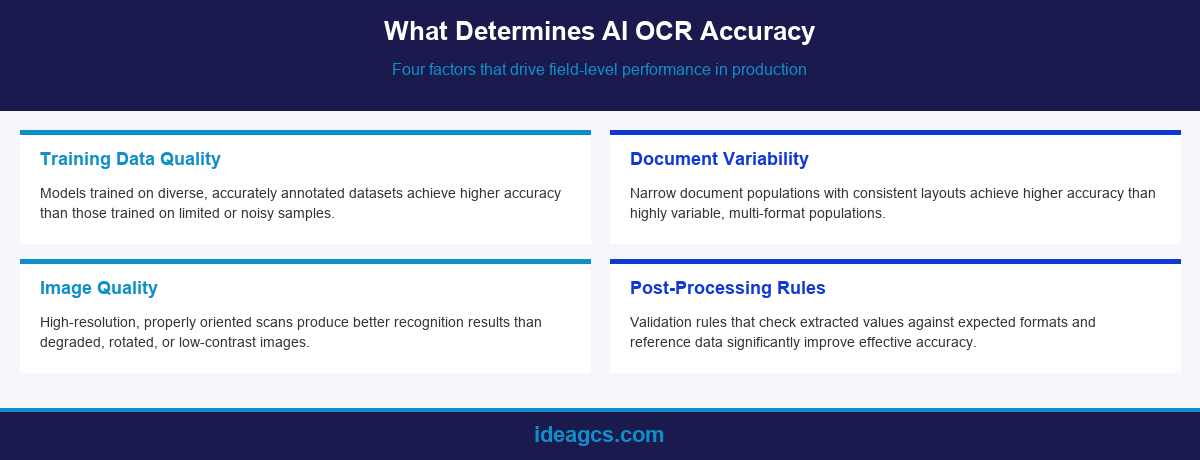
Training data insufficiency is the most common cause of below-expectation accuracy in production AI OCR systems. A model trained on 200 sample documents will underperform compared to one trained on 2,000 samples covering the full range of layout, font, and quality variations in the production document population. The gap between PoC accuracy (typically tested on curated, clean documents) and production accuracy (tested against real-world document diversity) reflects this training data insufficiency more than any limitation of the underlying technology.
Image quality directly affects recognition accuracy. Scanned documents with low resolution (below 200 DPI), significant skew, heavy background noise, or faded ink will produce lower extraction accuracy than high-quality digital originals. Post-processing validation rules, which check extracted values against expected formats (date formats, numeric ranges, currency codes) and reference data (supplier names, product codes), significantly improve effective accuracy by catching the errors that the model itself does not flag with low confidence. The absence of these rules is a common gap in AI OCR deployments that underperform against expectations.
How to Improve AI OCR Accuracy in Production
The most reliable accuracy improvement lever is systematic retraining. Every document that is corrected by a human reviewer in the exception queue represents a labelled training example: the model's extraction was incorrect, and the correct value is known. Feeding these corrections back into the training pipeline and periodically retraining the model on the augmented dataset consistently improves accuracy over successive cycles. Organisations that implement this feedback loop typically see accuracy improve by three to eight percentage points within the first six months of production operation. This approach is consistent with the continuous improvement methodology recommended by NIST's AI framework for production AI systems.
Image pre-processing improvements provide a faster accuracy gain for organisations whose document population includes significant proportions of low-quality scans. Investing in scan quality guidance for physical document capture, or upgrading scanning hardware, often delivers a larger and faster accuracy improvement than additional model training. IdeaGCS builds configurable image pre-processing pipelines into all AI OCR engagements, with controls for deskew, contrast enhancement, and noise reduction that can be tuned to match the specific quality characteristics of each client's document population. Contact IdeaGCS to discuss accuracy optimisation for your current or planned AI OCR deployment.
Measuring and Reporting AI OCR Accuracy
Accurate accuracy measurement requires a testing methodology that reflects the true diversity of the production document population. Testing against a curated sample of clean, structured documents systematically overestimates production accuracy. A representative test set should include examples of all document variants encountered in production, including lower-quality scans, edge-case layouts, and the full range of handwriting styles present in handwritten fields.
IdeaGCS provides field-level accuracy reporting as a standard component of all AI OCR engagements, tracking extraction accuracy per field, per document type, and per confidence band on a monthly basis. This reporting enables clients to identify specific field or document types where accuracy is below target and prioritise retraining investment accordingly. The accuracy dashboard is accessible to client teams throughout the engagement, providing full transparency into model performance over time. Explore our AI and data services to understand our accuracy monitoring and improvement process.
AI OCR accuracy of 95 to 99 percent on printed documents is achievable with adequate training data, quality image pre-processing, and robust post-processing validation. Below-expectation accuracy in production almost always traces to one of three root causes: insufficient training data diversity, inadequate image quality, or missing validation rules. All three are addressable with the right technical approach and a commitment to continuous retraining. The organisations that achieve the best long-term accuracy are those that treat their AI OCR deployment as a continuously improving system rather than a static installation. IdeaGCS builds AI OCR solutions with continuous improvement architectures. Explore our AI and data services to discuss your accuracy requirements.
Frequently Asked Questions
What accuracy rate should I expect from AI OCR?

Well-built AI OCR achieves 95 to 99 percent field-level accuracy on printed documents and 88 to 95 percent on handwritten content. Accuracy depends on training data quality, document variability, image quality, and the post-processing validation rules applied to extracted data.
Why is my AI OCR accuracy lower in production than in testing?
Production accuracy is typically lower than test accuracy because real-world documents are more diverse than test samples. Common causes include training data that does not cover all production document variants, lower scan quality in production than in the curated test set, and missing post-processing validation rules.
How can I improve AI OCR accuracy?
The most reliable improvements come from systematic retraining using corrected exception documents, improving scan quality through better hardware or capture guidance, adding post-processing validation rules for expected field formats, and expanding the training dataset to cover the full range of document variants in your population.
What is field-level accuracy in AI OCR?
Field-level accuracy measures the proportion of individual data fields extracted correctly, regardless of other fields in the same document. It is more informative than document-level accuracy and should be reported per field type to identify specific extraction weaknesses that can be targeted with additional training data.
How does training data quality affect AI OCR accuracy?
Training data quality directly determines model accuracy. A model trained on diverse, accurately annotated samples covering the full range of document variants performs significantly better than one trained on limited or homogeneous data. Each document type requires representative training samples to achieve high production accuracy.
Does AI OCR accuracy improve over time?
Yes. AI OCR accuracy improves over time when production-stage misclassifications are fed back into the training pipeline through a continuous retraining process. IdeaGCS builds retraining pipelines into all engagements, typically delivering accuracy improvements of 3 to 8 percentage points within the first six months of production operation.
What confidence score threshold should I set for AI OCR?
The optimal confidence threshold balances automation rate against accuracy. A higher threshold (above 0.90) means fewer documents process automatically but with higher accuracy. A lower threshold (above 0.75) processes more documents automatically but routes more exceptions for review. IdeaGCS recommends starting at 0.85 and adjusting based on production results.
How does image quality affect AI OCR accuracy?
Image quality significantly affects AI OCR accuracy. Resolution below 200 DPI, significant skew, heavy background noise, and faded ink all reduce extraction accuracy. IdeaGCS builds configurable pre-processing pipelines that correct common image quality issues before recognition, improving accuracy on poor-quality scans.
Contact Us
Share on Social Media
Contact Us